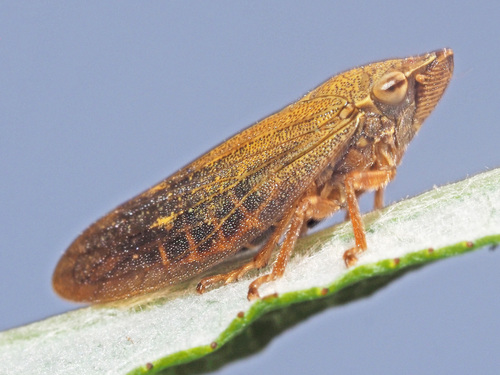
Willow Spittlebug
Aphrophora salicina
Look closely at the branches of your local willow tree and you might find a hidden architectural marvel. The Willow Spittlebug lives its youth inside a fortress of bubbles before transforming into one of the most powerful jumpers in the animal kingdom.
Quick Identification
Size
8-10 mm (0.31-0.39 inches) in length
Colors
Mottled yellowish-brown to greyish-brown; typically features two distinct pale creamy-white spots along the outer margin of the forewings.
Key Features
- Distinctive boat-shaped body with a pointed head
- Two pale spots on the edge of the forewings
- Nymphs produce white, frothy foam masses on willow twigs
- Powerful hind legs adapted for high-velocity jumping
When You’ll See Them
Behavior
The Willow Spittlebug is most famous for its juvenile stage, during which the nymph produces a bubbly, white foam known as "spittle" or "cuckoo spit." This foam is created by the insect pumping its body to whip excreted fluid and air together. This bubbly fortress serves multiple purposes: it hides the vulnerable nymph from predators, provides a moist microclimate to prevent desiccation, and insulates the insect against temperature fluctuations.
As adults, these insects transition into highly mobile "froghoppers." While they lose the protective foam, they gain the ability to jump distances hundreds of times their body length in a fraction of a second. They are generally solitary but can be found in high concentrations on a single host tree if conditions are ideal. Though they are capable of flight, they often prefer to walk sideways or jump when disturbed.
EverydayEarth exclusive
Camera Tips
Capturing the Willow Spittlebug requires a lens capable of close-up or macro photography. Because these insects are small and host-specific, your camera placement should be dictated entirely by the presence of Willow trees (Salix spp.). In the late spring, look for the conspicuous white foam on the stems of young willow shoots. This is the perfect stationary target for a time-lapse, as you can capture the growth of the spittle mass or the nymph occasionally surfacing for air.
To photograph the adults, you will need a camera with a fast trigger speed or high-frame-rate video capabilities. These insects are world-class jumpers, and capturing the moment of takeoff is a holy grail for backyard insect photographers. Set your camera on a tripod at branch-level, roughly 6 to 12 inches away from the foliage. Use a high shutter speed (at least 1/1000s) to freeze the motion, as their jumps are too fast for the human eye to track.
Since these bugs are diurnal, supplemental lighting is rarely needed, but a ring light or a diffused flash can help bring out the intricate mottled patterns on their wings. Position your camera to take advantage of side-lighting, which highlights the texture of the willow bark and the translucency of the spittle bubbles. If your camera has AI-detection for insects, ensure it is set to focus on the "eye" or the widest part of the thorax for the sharpest results.
Similar Species
Species that look similar or are commonly confused with Willow Spittlebug.
Frequently Asked Questions
Record Willow Spittlebug at your habitat
Connect a camera to start building your own species record — AI identifies every visitor automatically.