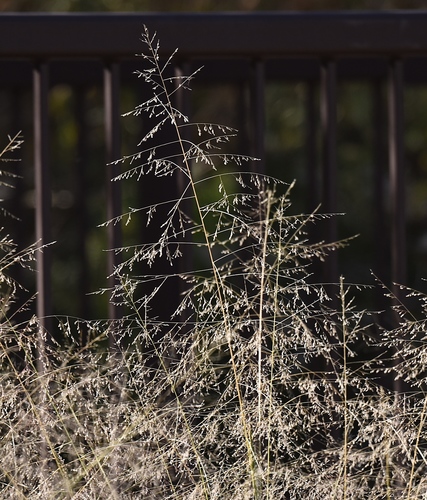
Alkali Sacaton
Sporobolus airoides
A hardy desert survivor known for its ethereal, cloud-like seed heads, Alkali Sacaton adds a misty texture to any landscape. This salt-tolerant bunchgrass is a vital refuge for backyard birds and a stunning subject for golden-hour photography.
Quick Identification
Size
Height: 0.5–1.5 meters (20–60 inches); Width: 0.3–1 meter (12–40 inches)
Colors
Grayish-green foliage; pinkish to purple-tinted seed heads that dry to a golden-tan
Key Features
- Dense, clumping perennial bunchgrass
- Large, airy, pyramidal seed heads (panicles)
- Tough, fibrous grayish-green leaf blades
- Forms distinct, rounded mounds often referred to as 'sacatons'
When You’ll See Them
Geographic range
Where Does the Alkali Sacaton Live?
Native to the sun-drenched landscapes of Western North America, Alkali Sacaton is a resilient resident of the Great Basin, the Mojave, and the Chihuahuan deserts. Its range extends from the southern reaches of British Columbia and Alberta in Canada, through the Western United States as far east as the Mississippi River, and down into the central highlands of Mexico. This grass is an expert at colonizing harsh environments where other plants struggle, particularly in high-salinity valley floors and alkaline flats.
Basemap © OpenStreetMap contributors
Behavior
As a perennial bunchgrass, Alkali Sacaton is a master of endurance, specifically evolved to thrive in the high-sodium, poorly drained soils of the American West. It grows in dense, tough clumps that can survive for many years, slowly expanding its base to create a micro-habitat for soil organisms. Its deep, vigorous root system allows it to tap into moisture deep underground, making it incredibly drought-tolerant and a vital stabilizer for desert soils against wind erosion.
In the ecosystem, this grass serves as a foundation species. Its thick, mounded structure provides critical nesting sites and thermal cover for ground-dwelling birds and small mammals. While it is a hardy survivor, it is not aggressive; instead, it provides a stable environment for other desert flora and fauna to coexist. During the summer months, its massive production of tiny, nutrient-rich seeds provides a seasonal feast for dozens of species of migratory and resident songbirds.
EverydayEarth exclusive
Camera Tips
Capturing the ethereal beauty of Alkali Sacaton requires a focus on movement and lighting. Because its fine, airy panicles sway in the slightest breeze, they can sometimes trigger motion-sensitive cameras frequently. To avoid a memory card full of false triggers, consider adjusting your AI camera’s sensitivity or focusing your 'Activity Zones' on the base of the plant where larger animals or ground-feeding birds are likely to appear. Setting the camera at a low angle, roughly 12-18 inches off the ground, will allow you to capture the impressive architecture of the bunchgrass while catching the small mammals and reptiles that take shelter within its dense crown.
The best time to photograph this species is during the 'golden hour'—just after sunrise or before sunset. The fine seed heads catch the light, creating a glowing, backlit halo effect that is truly spectacular. If your camera allows for manual exposure or has an HDR mode, use it to preserve the detail in the delicate, purple-tinged plumes without blowing out the highlights. Position your camera facing toward the sun (but slightly offset) to get that backlit shimmer that makes this grass so famous in western landscapes.
During the late summer and autumn months, Alkali Sacaton becomes a magnet for seed-eating birds like sparrows, finches, and towhees. This is the ideal time to set up a trail camera nearby. Aim the lens at the seed heads themselves, or place the camera near a water source adjacent to the grass. The density of the grass provides excellent cover, so birds will often hop from the safety of the foliage to the open ground and back again, giving you multiple chances for a clear shot. Use a fast shutter speed or a high frame rate setting to freeze the rapid motion of these small birds as they forage.
Similar Species
Species that look similar or are commonly confused with Alkali Sacaton.
Frequently Asked Questions
Record Alkali Sacaton at your habitat
Connect a camera to start building your own species record — AI identifies every visitor automatically.