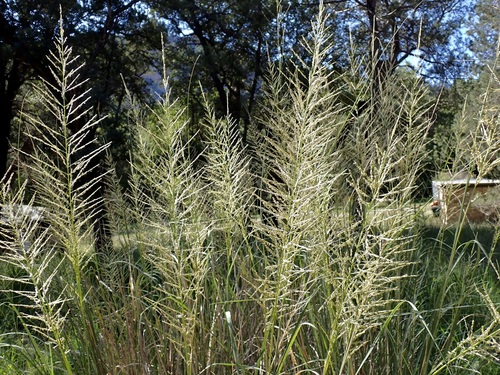
big sacaton
Sporobolus wrightii
A majestic, fountain-like bunchgrass that defines the Southwestern landscape. Big Sacaton provides critical sanctuary for desert wildlife and adds a dramatic, golden elegance to any wild-scaped backyard.
Quick Identification
Size
Height of 3–8 feet (0.9–2.4 m) and a spread of 3–6 feet (0.9–1.8 m)
Colors
Grey-green to blue-green foliage; airy bronze or tan seed panicles; turns golden-straw color in winter
Key Features
- Massive, fountain-like bunchgrass habit
- Feathery, branched seed heads up to 2 feet long
- Coarse, flat leaf blades up to 1/2 inch wide
- Forms dense, elevated hummocks over time
When You’ll See Them
Geographic range
Where Does the big sacaton Live?
Big Sacaton is native to the vast, arid reaches of the North American Southwest and Northern Mexico. It is most commonly found throughout the Sonoran and Chihuahuan deserts, with significant populations spanning from Arizona and New Mexico into West Texas and Southern Oklahoma. Beyond the United States border, its range extends deep into Central Mexico, flourishing in states like Chihuahua, Durango, and San Luis Potosí where it thrives in seasonally flooded basins and along the edges of desert washes.
Basemap © OpenStreetMap contributors
Behavior
Big Sacaton is a perennial warm-season bunchgrass that acts as a foundational "habitat engineer" in arid environments. Unlike turf grasses, it grows in large, distinct clumps that provide structural complexity to the landscape. During the hot summer months, these massive hummocks create essential thermal cover, offering a cool microclimate for reptiles and small mammals to escape the desert heat. Its growth cycle is closely tied to the North American monsoon, exploding with green growth and feathery seed heads as the rains arrive in mid-to-late summer.
For homeowners and wildlife enthusiasts, Big Sacaton serves as a living security system for birds. The dense, upright foliage is nearly impenetrable to many predators, making it a preferred nesting site for ground-nesting birds and a safe harbor for sparrows and towhees. While it is incredibly drought-tolerant once established, it thrives in areas with occasional deep watering, such as floodplains or suburban rain gardens, where it can reach its full, majestic height. In the winter, the grass remains standing, providing architectural interest and a steady supply of seeds for overwintering wildlife.
EverydayEarth exclusive
Camera Tips
Capturing wildlife interacting with Big Sacaton requires a strategy focused on the 'neighborhood' the grass creates. Because the blades move easily in the wind, you must be careful with your camera’s PIR (motion) sensitivity. Set your camera to 'Medium' or 'Low' sensitivity if the grass is directly in the frame to avoid hundreds of 'false triggers' on breezy days. Ideally, position the camera 3-5 feet away from the base of a large clump, angled slightly downward to capture the small mammals and lizards that use the base of the hummock for cover.
For bird enthusiasts, the tall seed heads (panicles) are a magnet for granivores like sparrows and finches in late summer and fall. Mount your camera on a T-post or tripod at a height of about 4-5 feet, facing the seed heads. Use a fast shutter speed or 'Blur Reduction' setting if your camera has it, as birds flitting through the airy seeds move quickly. Early morning and late afternoon light hitting the bronze seed heads provides the most dramatic, professional-looking 'golden hour' footage.
During the winter, Big Sacaton becomes a focal point for activity when other cover is sparse. This is the best time to look for larger mammals like javelina or coyotes that may use the tall, golden clumps as a windbreak or for hunting rodents. Position cameras along the 'edges' where the grass meets open ground. If you are using a bait or lure to attract animals to the area, place it in the open space just in front of the grass clump to ensure the camera captures the animal emerging from the safety of the foliage.
Finally, don't overlook time-lapse mode. Big Sacaton's transformation from a dormant golden bunch in June to a lush green fountain in August is a spectacular visual of the desert's resilience. Setting your camera to take one or two photos a day throughout the monsoon season can create a stunning document of how this plant responds to water and provides for the ecosystem.
Similar Species
Species that look similar or are commonly confused with big sacaton.
Frequently Asked Questions
Record big sacaton at your habitat
Connect a camera to start building your own species record — AI identifies every visitor automatically.