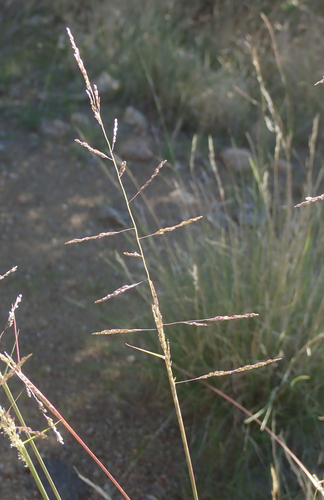
Sand Dropseed
Sporobolus cryptandrus
A resilient native bunchgrass with striking lead-colored seed heads, Sand Dropseed is a vital provider of food and shelter for North American backyard wildlife.
Quick Identification
Size
Stems reach 30–100 cm (12–40 inches) in height with panicles 15–40 cm long
Colors
Lead-colored to purplish-gray seed heads; grayish-green leaves turning straw-colored in winter
Key Features
- Lead-gray contracted panicle often partially enclosed in the leaf sheath
- Prominent tuft of white hairs at the leaf collar
- Erect or sprawling bunchgrass growth habit
- Small, shiny seeds that drop easily when ripe
When You’ll See Them
Geographic range
Where Does the Sand Dropseed Live?
Native to North America, Sand Dropseed is an incredibly hardy grass that blankets landscapes from the southern provinces of Canada across the vast majority of the United States and down into northern Mexico. It is most at home in the sandy soils of the Great Plains and the arid regions of the Southwest, where it serves as a critical pioneer species for stabilizing dunes and disturbed earth. Its wide distribution makes it one of the most common native grasses you'll encounter in North American prairies and coastal regions alike.
Basemap © OpenStreetMap contributors
Behavior
Sand Dropseed is a perennial bunchgrass known for its remarkable resilience and its role as a pioneer species in sandy environments. It earns its name from its habit of releasing thousands of tiny, grain-like seeds that drop to the ground as they mature. A unique characteristic of this grass is that its flowering head, or panicle, often remains partially or entirely wrapped within the uppermost leaf sheath, a trait reflected in its scientific name cryptandrus, meaning 'hidden male.'
In a backyard ecosystem, Sand Dropseed acts as a foundational species. It doesn't just sit still; it responds dynamically to the environment, bowing low during heavy winds and providing a sturdy architectural element during winter months. It serves as a vital 'nursery' for small creatures, offering protected corridors for insects and small mammals to move through without being spotted by predators.
EverydayEarth exclusive
Camera Tips
Using an AI camera to monitor Sand Dropseed is a fantastic way to see the 'hidden' wildlife in your yard. Position your camera at a very low angle, about 10–15 inches from the ground, aiming horizontally through a cluster of the grass. Because the seeds are a major food source, this setup will capture ground-feeding birds like Dark-eyed Juncos and various sparrows that are often missed by higher-mounted cameras.
Movement can be a challenge with grasses; the swaying stalks may trigger your motion sensor frequently. To counter this, reduce the motion sensitivity in your camera settings or use 'Time Lapse' mode with 5-minute intervals during the morning and evening. This allows you to watch the grass develop over the season and see which animals visit the patch without filling your SD card with wind-blown grass videos.
For the best image quality, place your camera so the sun is behind it, illuminating the lead-colored seed heads. In the late afternoon, the 'Golden Hour' light catches the white hairs at the leaf collars, creating a beautiful halo effect. If you are looking to capture insects like grasshoppers or ladybugs that frequent the stalks, ensure your camera has a good minimum focus distance (macro capability) to keep the fine details of the plant sharp.
Similar Species
Species that look similar or are commonly confused with Sand Dropseed.
Frequently Asked Questions
Record Sand Dropseed at your habitat
Connect a camera to start building your own species record — AI identifies every visitor automatically.