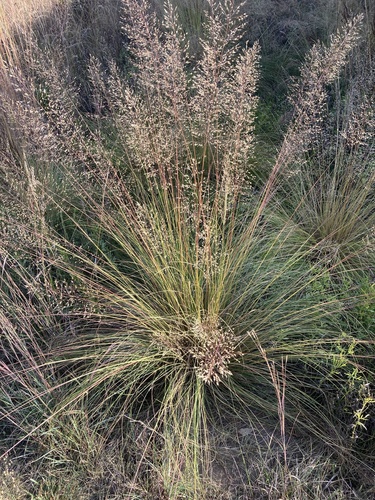
prairie dropseed
Sporobolus heterolepis
The most elegant of the native grasses, prairie dropseed offers stunning 'fountain' foliage and a unique popcorn fragrance that defines the late-summer prairie.
Quick Identification
Size
Foliage clumps reach 15-24 inches (38-61 cm) tall and wide; flower stalks rise to 3 feet (91 cm).
Colors
Deep emerald green foliage in summer, shifting to golden-orange or coppery-bronze in autumn.
Key Features
- Fine, hair-like foliage forming a fountain-like mound
- Pinkish-brown airy flower panicles
- Distinctive popcorn or coriander fragrance when in bloom
- Seeds held on thin, arching stems that 'drop' when ripe
When You’ll See Them
Geographic range
Where Does the prairie dropseed Live?
This quintessential grass is a staple of the North American prairie heartland, with its core range extending from the southern plains of Texas up through the Midwestern United States into the Canadian provinces of Saskatchewan, Manitoba, and Ontario. While it is most concentrated in the Great Plains, it can also be found in scattered, specialized habitats along the Atlantic coast, from Quebec down to North Carolina. It is a resilient species that has become a favorite for sustainable landscaping across the continental United States due to its drought tolerance.
Basemap © OpenStreetMap contributors
Behavior
Prairie dropseed is a long-lived, warm-season perennial bunchgrass that is highly regarded for its ornamental elegance and ecological value. Unlike many aggressive prairie grasses, it grows in a tidy, discrete mound, expanding slowly over several years. It is most famous for its late-summer bloom, when delicate, airy seed heads rise above the foliage and emit a unique scent that many people compare to toasted popcorn, roasted nuts, or coriander.
Ecologically, the plant acts as a foundational species in the prairie ecosystem. In the summer, its dense, fine-textured blades provide nesting material and cover for various insects. As winter approaches, the foliage collapses to form a protective 'skirt' around the base of the plant, creating a micro-habitat for overwintering beneficial insects and small mammals. Its heavy, nutritious seeds are a critical late-season food source for ground-feeding birds.
EverydayEarth exclusive
Camera Tips
Capturing the life surrounding prairie dropseed requires a focus on both movement and the visiting wildlife. To get the best shots, position your camera at a low 'critter-eye' level, roughly 10 to 15 inches off the ground. This angle allows you to capture the arching, fountain-like structure of the grass while also spotting the sparrows, juncos, and small mammals that forage for seeds beneath the canopy of the blades in late autumn.
Because the grass stays in one place, it is the perfect subject for time-lapse photography. Set your camera to take a photo once or twice a day from late August through November. This will create a beautiful visual sequence of the plant's dramatic color transformation from vibrant green to deep copper. If your camera has a motion trigger, be aware that wind can cause the fine blades to sway, potentially filling your SD card with 'empty' captures; set your sensitivity to medium or high, but use 'zone masking' to focus the trigger on the ground area at the base of the plant where birds are likely to land.
In the early morning, the fine foliage of prairie dropseed is exceptional at catching dew and frost, which looks spectacular on high-definition trail cameras. For the best lighting, face your camera east or west to catch the low-angled sun as it backlights the airy seed heads, making them appear to glow. This is the best time to catch insects like ladybugs or native bees that may be using the dense grass for overnight shelter.
Similar Species
Species that look similar or are commonly confused with prairie dropseed.
Little Bluestem
Little Bluestem grows more upright and blue-tinted in summer, turning a vivid red-purple in fall, whereas dropseed is more mounded and copper-colored.
Sideoats Grama
Sideoats Grama has distinct seeds that hang off one side of the stem, whereas prairie dropseed has an airy, branching 'cloud' of seeds.
Frequently Asked Questions
Record prairie dropseed at your habitat
Connect a camera to start building your own species record — AI identifies every visitor automatically.