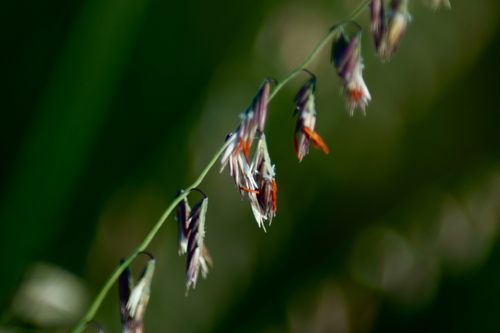
Sideoats Grama
Bouteloua curtipendula
The crown jewel of the shortgrass prairie, Sideoats Grama features delicate, oat-like seeds that dangle elegantly from one side of its stem. This hardy perennial is more than just a beautiful landscape plant; it is a vital host and food source for a wide array of backyard pollinators and songbirds.
Quick Identification
Size
12 to 36 inches (30 to 91 cm) tall; 12 to 18 inches (30 to 45 cm) wide
Colors
Blue-green leaves in summer; bright orange-red or purple anthers; matures to golden-tan or reddish-bronze in winter
Key Features
- Oat-like seed spikes hanging from only one side of the stem
- Bright orange-red or purple anthers visible during summer flowering
- Narrow, blue-green leaf blades that often curl when dry
- Distinctive clump-forming (bunchgrass) growth habit
- Zig-zagging stem tips where seeds attach
When You’ll See Them
Behavior
Sideoats Grama is a perennial, warm-season bunchgrass that serves as a foundational species for North American prairies. Unlike invasive turf grasses, it grows in tidy, attractive clumps that don't crowd out neighboring flowers. It is remarkably drought-tolerant, using its deep root system to thrive in rocky or sandy soils where other plants might struggle. It reaches its peak beauty in mid-to-late summer when its unique flowering spikes emerge.
As a key component of a wildlife-friendly backyard, this grass plays a quiet but vital role. It doesn't move much on its own, but it reacts beautifully to the wind, creating a rhythmic swaying motion that adds texture to your landscape. It is a 'social' plant in the sense that it fosters a massive amount of insect diversity, acting as a nursery for butterflies and a structural home for beneficial predatory insects like ladybugs and lacewings.
EverydayEarth exclusive
Camera Tips
To capture the architectural beauty of Sideoats Grama, position your camera low to the ground, roughly 12 to 18 inches high. Angle the lens slightly upward to frame the seed heads against the sky or a contrasting background. Because the most distinctive feature—the 'side-hanging' seeds—is relatively small, placing the camera within 2 to 3 feet of the plant is essential for clear identification. Avoid placing the camera too far away, or the fine texture of the grass will blur into the background.
Lighting is your best friend when filming this species. Try to orient your camera facing East or West so the morning or evening sun 'backlights' the seed heads. This creates a halo effect around the bright orange anthers and the delicate hairs on the stems, making them pop in photos. If your camera has a 'Macro' or 'Close-Up' setting, this is the perfect time to use it. High-definition video mode is also highly recommended; the way Sideoats Grama dances in a light breeze is one of its most charming traits and looks much better in motion than in a still photo.
If you are using an AI-powered camera like those from EverydayEarth, use Sideoats Grama as a 'natural lure.' While you aren't baiting the grass itself, the plant acts as a magnet for birds like Chipping Sparrows and Juncos in the fall. Set your motion trigger sensitivity to 'High' to catch the rapid movements of skippers and hairstreak butterflies that use this grass as a host plant. During the winter, keep the camera rolling; the tan stalks provide great contrast against the snow and will help you document which birds are visiting your yard for winter forage.
For a unique project, try a time-lapse setting. Over the course of July and August, you can record the dramatic transformation of the flowers from tiny purple nubs into the iconic hanging 'oats.' Ensure your camera is mounted on a sturdy stake or T-post rather than a flexible branch, as any camera shake will ruin the time-lapse effect during windy prairie days.
Similar Species
Species that look similar or are commonly confused with Sideoats Grama.
Blue Grama
Blue Grama features seed heads that curve horizontally like a 'comb' or 'eyebrow,' whereas Sideoats has seeds hanging vertically along the side.
Little Bluestem
Little Bluestem turns a much deeper mahogany-red in winter and has fluffy, white tufted seeds rather than oat-like spikes.
Canada Wild Rye
Wild Rye has thick, nodding seed heads that resemble domestic rye or wheat, much heavier than the delicate spikes of Sideoats Grama.
Frequently Asked Questions
Record Sideoats Grama at your habitat
Connect a camera to start building your own species record — AI identifies every visitor automatically.