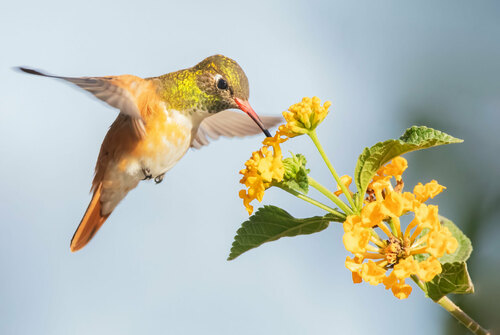
Amazilia Hummingbird
Amazilis amazilia
A shimmering jewel of the Pacific coast, the Amazilia Hummingbird is a bold and feisty resident of South American gardens. Easily recognized by its striking rufous tail, this adaptable bird brings a flash of iridescent green to both wild scrublands and busy city centers.
Quick Identification
Size
9-11 cm (3.5-4.3 in) in length; weighs approximately 4-7 g (0.14-0.25 oz)
Colors
Golden-green upperparts, distinct rufous (reddish-brown) tail, and white to buff underparts; bill is reddish with a black tip.
Key Features
- Distinctive rufous or cinnamon-colored tail
- Reddish lower mandible with a dark tip
- Golden-green iridescent upperparts
- White or pale buff belly depending on the subspecies
When You’ll See Them
Geographic range
Where Does the Amazilia Hummingbird Live?
The Amazilia Hummingbird is a characteristic resident of the South American Pacific coast. Its native range stretches from western Ecuador through the arid coastal regions and Andean foothills of Peru. Because it adapts so well to human-modified landscapes, it is a frequent sight in major metropolitan areas like Lima, thriving wherever flowering gardens and parks provide a reliable source of nectar.
Basemap © OpenStreetMap contributors
Behavior
During the day, they follow a 'trap-lining' foraging strategy, visiting a specific circuit of flowering plants, or they may choose to guard a high-reward patch of flowers. When not feeding, they often perch on thin, exposed branches to survey their territory, occasionally performing rapid preening sessions to keep their flight feathers in top condition.
EverydayEarth exclusive
Camera Tips
To capture the best images of the Amazilia Hummingbird, focus your camera on high-reward nectar sources like red or orange tubular flowers. Because this species is highly territorial, it will likely have a favorite 'sentinel' perch nearby—usually a bare, thin twig with a clear view of the flowers. Positioning your camera to face this perch will yield much clearer, still photos than trying to catch them mid-flight.
For action shots, set your AI camera to a high trigger speed. These birds are extremely fast, and even a slight delay can result in a frame containing nothing but a blurred tail. Ensure the area is bathed in bright, direct sunlight; this not only allows for faster shutter speeds but also highlights the brilliant iridescence of their golden-green feathers and the rich tones of their rufous tail.
If you are using a backyard feeder to attract them, place the camera at a 45-degree angle to the feeder rather than head-on. This perspective captures the bird’s profile, including the distinctive reddish bill and the contrast between the green back and pale belly. Early morning is the best time for filming, as they are most active when flowers first replenish their nectar levels.
Similar Species
Species that look similar or are commonly confused with Amazilia Hummingbird.
Frequently Asked Questions
Record Amazilia Hummingbird at your habitat
Connect a camera to start building your own species record — AI identifies every visitor automatically.