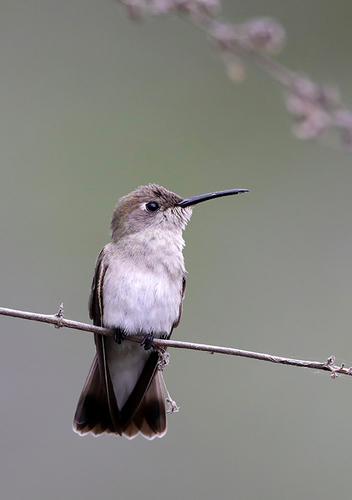
Tumbes Hummingbird
Thaumasius baeri
A resilient specialist of the South American dry forests, the Tumbes Hummingbird is an understated beauty. This hardy nectar-seeker brings life to the arid scrublands of Ecuador and Peru with its swift flight and bold personality.
Quick Identification
Size
8.5–10 cm (3.3–3.9 in) in length; weight approximately 4–5 g (0.14–0.18 oz)
Colors
Dull grayish-green upperparts and crown; pale grayish-white underparts; small white spot behind the eye; black bill
Key Features
- Small white post-ocular spot
- Drab grayish-white underparts without heavy spotting
- Relatively long, slightly decurved black bill
- Pale tips on outer tail feathers
- Medium-sized hummingbird with a stocky profile
When You’ll See Them
Geographic range
Where Does the Tumbes Hummingbird Live?
This species is a South American specialist native to the Tumbesian region. Its core range is concentrated in southwestern Ecuador and northwestern Peru, stretching along the coastal lowlands and foothills. It is a signature bird of the dry Pacific forests, thriving in areas that many other hummingbirds find too arid.
Basemap © OpenStreetMap contributors
Behavior
The Tumbes Hummingbird is a hardy and energetic resident of the arid scrublands along the Pacific coast. Unlike many of its more vibrantly colored relatives, this species has adapted to thrive in harsh, dry environments where it can be seen darting between cacti and flowering shrubs. It is primarily solitary and can be quite territorial over high-quality nectar sources, often chasing away larger competitors with surprising bravado.
In backyard settings within its range, it is known for being relatively bold and habituated to human presence. It forages at low to middle heights, usually below three meters, moving with a direct and rapid flight pattern. During the heat of the day, it may retreat into the shade of thickets, becoming most active during the cooler morning and late afternoon hours when flowers are most productive.
EverydayEarth exclusive
Camera Tips
To successfully capture a Tumbes Hummingbird on your EverydayEarth camera, location is everything. These birds are highly nectar-dependent, so place your camera near native flowering plants like Cactaceae or Fabaceae species. Positioning the camera at a height of 3 to 5 feet (roughly 1 to 1.5 meters) is ideal, as this species prefers foraging at mid-level heights rather than high in the canopy.
Lighting can make or break a hummingbird photo. Because the Tumbes Hummingbird has subtle, grayish-green plumage rather than bright iridescent patches, you need good sunlight to bring out its detail. Try to orient your camera facing north or south to avoid direct lens flare while ensuring the bird is well-lit by the morning or afternoon sun. If your camera supports it, use a high-speed trigger or burst mode to catch the fast-moving wing beats.
If you are using a hummingbird feeder to attract them, place the camera 12 to 18 inches away from the feeder port. Using a 'perch'—a small twig placed just a few inches from the feeder—can encourage the bird to land and rest, giving your camera a perfect opportunity to capture a still, clear image. In the dry season, a shallow water mister can be an even more effective lure than food, as these birds frequently seek out water for bathing and cooling down.
Similar Species
Species that look similar or are commonly confused with Tumbes Hummingbird.
Frequently Asked Questions
Record Tumbes Hummingbird at your habitat
Connect a camera to start building your own species record — AI identifies every visitor automatically.