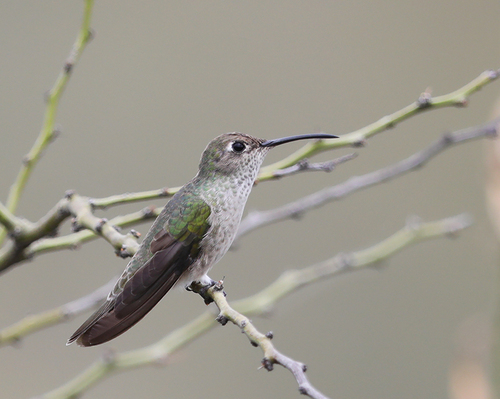
Spot-throated Hummingbird
Thaumasius taczanowskii
A Peruvian endemic with a charmingly freckled throat, the Spot-throated Hummingbird is a master of the dry Andean valleys. This resilient emerald is a frequent visitor to gardens where it displays remarkable aerial agility.
Quick Identification
Size
Length: 11.5–12.5 cm (4.5–5 in); weight: 7–8 g (0.25–0.28 oz)
Colors
Bronzy-green upperparts; whitish-gray underparts with dense green or dusky spots on the throat and breast
Key Features
- Prominent dusky green spots on the throat and upper breast
- Long, slightly decurved black bill
- Bronzy-green crown and back with a pale grayish-white belly
When You’ll See Them
Geographic range
Where Does the Spot-throated Hummingbird Live?
Native to South America, the Spot-throated Hummingbird is a unique endemic found exclusively in Peru. Its core range is centered in the Marañón River valley and the western slopes of the Andes, where it thrives in the rain shadows of the mountain range. While occasional unconfirmed sightings have been reported just across the border in southern Ecuador, it remains a hallmark species of the dry Peruvian interior.
Basemap © OpenStreetMap contributors
Behavior
The Spot-throated Hummingbird is a spirited and territorial resident of the dry valleys of Peru. Often seen darting between flowering shrubs, it is known for its "trap-lining" foraging strategy, where it follows a consistent route to visit specific nectar-producing plants throughout the day. It is a bold bird that does not hesitate to chase off larger competitors from its preferred feeding patches.
While many hummingbirds are known for their brilliant iridescence, this species is more subtle, relying on its camouflaged, spotted plumage to blend into the shadows of arid scrublands. In suburban environments, they are frequent visitors to gardens and are quite comfortable around human activity, often perching on low, exposed branches between feeding sessions to scan for intruders or passing insects.
EverydayEarth exclusive
Camera Tips
To capture high-quality footage of the Spot-throated Hummingbird, focus your camera on high-reward nectar sources. In a backyard setting, this means placing your AI-powered camera within 2 to 3 feet of a hummingbird feeder or a cluster of native red tubular flowers. Because these birds move with incredible speed, ensure your camera is set to its highest frame rate or use a 'fast-motion' trigger setting to avoid a blurred image.
Proper lighting is essential to showcase the bird's namesake spots. Position your camera to take advantage of direct morning or afternoon sunlight, which helps illuminate the throat area. If the bird is backlit, the throat will appear as a solid dark mass, hiding the distinctive freckled pattern that defines the species. Aim the camera at a slightly upward angle if the bird is feeding from hanging flowers, as this will best capture the ventral markings.
In more natural trail settings, look for 'sentinel perches'—small, dead twigs that protrude from bushes near food sources. These hummingbirds often return to the same twig to rest and digest between feedings. By pre-focusing your camera on one of these perches, you are far more likely to get a sharp, still image than if you try to catch them in flight. Early morning is the best time for activity, as they need to replenish calories lost during the cool Andean nights.
Similar Species
Species that look similar or are commonly confused with Spot-throated Hummingbird.
Frequently Asked Questions
Record Spot-throated Hummingbird at your habitat
Connect a camera to start building your own species record — AI identifies every visitor automatically.