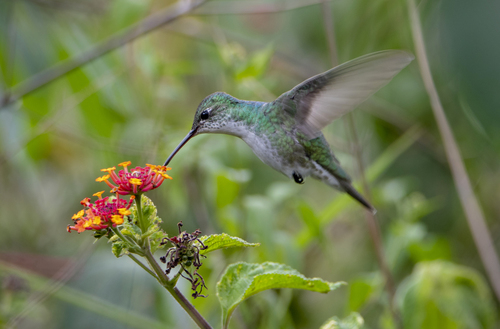
Green-and-white Hummingbird
Elliotomyia viridicauda
Meet the Green-and-white Hummingbird, a dazzling gem found only in the misty mountain forests of Peru. With its snowy white belly and emerald back, this agile flyer is a favorite for backyard birders in the Andes.
Quick Identification
Size
10–11 cm (3.9–4.3 in) long; weighs approximately 5–6 g (0.18–0.21 oz)
Colors
Metallic bronze-green upperparts; solid white throat, breast, and belly; gold-green tail with pale greyish tips
Key Features
- Pure white underparts from chin to vent
- Shimmering bronze-green crown and back
- Straight to slightly decurved black bill
- Endemic to the Peruvian Andes
When You’ll See Them
Geographic range
Where Does the Green-and-white Hummingbird Live?
This stunning hummingbird is found exclusively in South America as a proud endemic of Peru. It occupies a relatively narrow band along the eastern slopes of the Andes, stretching from the northern regions of Amazonas down through the central valleys to the Cusco area. It is a true mountain specialist, thriving in the lush, mist-covered transition zones between high-altitude forests and settled valleys.
Basemap © OpenStreetMap contributors
Behavior
The Green-and-white Hummingbird is a highly active and somewhat territorial resident of the Peruvian cloud forests and garden edges. It is often observed zip-lining through the understory, moving between nectar sources with precision. While it can be bold around feeders, it is generally less aggressive than the larger 'brilliant' or 'sword-billed' hummingbirds, often waiting for its turn or feeding during quieter periods of the day.
This species follows a foraging strategy known as 'trap-lining,' where it visits a specific circuit of flowering plants at regular intervals. It is also quite inquisitive; it has been known to hover inches away from hikers or garden equipment to inspect anything new in its territory. During the breeding season, males perform small aerial displays, though they are generally solitary outside of mating.
EverydayEarth exclusive
Camera Tips
To capture the Green-and-white Hummingbird on camera, your best bet is to focus on its favorite nectar sources. In a backyard or trail setting, place your camera near tubular red or purple flowers like Salvia, Fuchsia, or local Peruvian lilies. Mount the camera roughly 4 to 5 feet off the ground, angled slightly upward to catch the bird's distinctive white underparts as it hovers. If you are using an AI-powered camera near a feeder, ensure the perch is within 2 to 3 feet of the lens for maximum detail.
Because hummingbirds move their wings at incredible speeds, motion blur is a common issue. If your camera settings allow, use a high shutter speed or a 'burst' mode triggered by motion. The Green-and-white Hummingbird is most active in the early morning light; positioning your camera so the sun is behind it (shining onto the bird) will highlight the metallic bronze-green sheen of its feathers, which can otherwise look dark or dull in the shade.
Be patient with your placement. These birds are creatures of habit and will likely return to the same flower every 15 to 20 minutes. If you notice a particular branch where the bird likes to 'guard' its territory, that is the perfect spot for a stationary camera. Avoid using artificial flash, as the sudden light can startle them; natural, bright morning light is always the best choice for these high-altitude gems.
Similar Species
Species that look similar or are commonly confused with Green-and-white Hummingbird.
Frequently Asked Questions
Record Green-and-white Hummingbird at your habitat
Connect a camera to start building your own species record — AI identifies every visitor automatically.