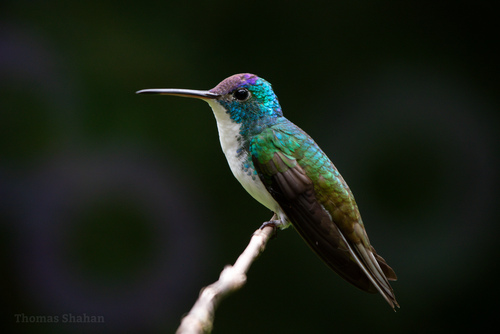
Andean Emerald
Uranomitra franciae
A shimmering jewel of the high Andes, the Andean Emerald is easily identified by its snow-white underparts and glittering violet crown. A frequent visitor to mountain gardens, this bird brings a flash of iridescent color to any backyard camera.
Quick Identification
Size
9–10 cm (3.5–3.9 in) in length; weighs 4.5–5.5 grams
Colors
Metallic green upperparts with a bright white throat and belly. Males feature a glittering violet-blue crown, while females have a green crown.
Key Features
- Bright snow-white underparts
- Glittering violet-blue crown on males
- Straight bill with a reddish-pink base on the lower mandible
- Medium-length, slightly notched bronzy-green tail
When You’ll See Them
Geographic range
Where Does the Andean Emerald Live?
South America is the native home of this glittering species, specifically along the humid slopes and valleys of the Andes Mountains. The Andean Emerald's core range extends through the montane regions of Colombia, western and eastern Ecuador, and northern Peru. Because they adapt so well to human-altered landscapes, they are frequently found in rural gardens and agricultural areas throughout these tropical and subtropical highlands.
Basemap © OpenStreetMap contributors
Behavior
The Andean Emerald is a spirited and highly active hummingbird known for its territorial nature. In the wild, they are often observed as 'trap-liners,' meaning they follow a specific daily route between various flowering plants. However, in garden settings, they can become quite possessive over a single rich nectar source, such as a hummingbird feeder or a blooming shrub, aggressively chasing away other hummingbirds and even larger insects.
While they are solitary birds, they are remarkably well-adapted to human presence. They are frequently seen perching on low, exposed branches or wires between feeding bouts, where they sit upright to survey their territory. Their flight is rapid and direct, and they possess the classic hummingbird ability to hover with extreme precision while feeding or inspecting potential threats.
EverydayEarth exclusive
Camera Tips
To capture the Andean Emerald on a backyard camera, placement is everything. Since these birds are 'low-to-middle' level foragers, set your AI camera at a height of 4 to 6 feet, ideally angled toward a cluster of red or tubular orange flowers like Salvia or Fuchsia. If using a feeder to attract them, ensure the camera is positioned about 12 to 18 inches away to capture the fine details of their iridescent plumage without losing focus or blowing out the highlights. Use a fast shutter speed setting if your camera allows, as their wingbeats are incredibly rapid.
Lighting is the secret to getting that perfect violet-blue crown shot. Position your camera so the sun is behind it (facing East in the afternoon or West in the morning); this 'front-lighting' allows the structural colors of the feathers to refract light back into the lens, revealing the brilliant emerald and violet hues that otherwise look dark in the shade. Avoid deep shade, as the camera's AI might struggle to distinguish the bird's white belly against a bright, blown-out background.
During the dry season, adding a misting feature or a shallow stone water basin near your camera can be a game-changer. Andean Emeralds love to bathe and will often return to the same spot daily for a quick dip. Set your camera to 'Burst Mode' or high-frame-rate video to catch the split-second action of them shaking water from their wings. For the best activity, ensure your camera is active during the 'golden hours' shortly after sunrise and before sunset when nectar production is often at its peak.
Similar Species
Species that look similar or are commonly confused with Andean Emerald.
Frequently Asked Questions
Record Andean Emerald at your habitat
Connect a camera to start building your own species record — AI identifies every visitor automatically.