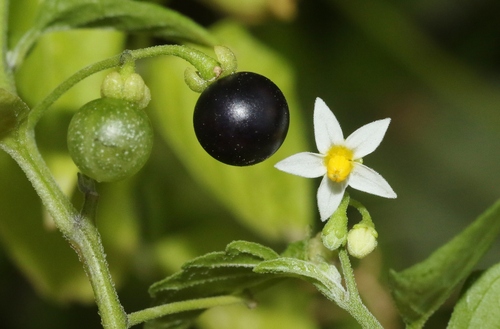
American black nightshade
Solanum americanum
A resilient and ubiquitous wildflower of the Americas, the American black nightshade is a vital source of food for birds and a fascinating example of backyard biodiversity.
Quick Identification
Size
Height ranges from 30 to 120 cm (12 to 47 inches) with a spread of 30 to 60 cm (12 to 24 inches).
Colors
Deep green foliage often with purple-tinged stems; small white or pale violet star-shaped flowers with bright yellow centers; berries ripen from green to a high-gloss black.
Key Features
- Small star-shaped flowers with five petals and a central yellow cone of anthers
- Berries are produced in small clusters and turn a distinctive glossy black when mature
- Leaves are oval-shaped with slightly wavy margins and a soft texture
- Stems are typically herbaceous and can be either smooth or slightly hairy
When You’ll See Them
Geographic range
Where Does the American black nightshade Live?
Native to the Americas, this species is widely distributed from the southern United States through Central America and deep into South America. It has successfully naturalized across many other parts of the world, including parts of Africa, Asia, and Oceania, due to its resilient nature and seed dispersal by birds. In its core range, it is a ubiquitous sight in both rural landscapes and urban alleyways, thriving wherever the soil has been recently disturbed.
Basemap © OpenStreetMap contributors
Behavior
American black nightshade is a fast-growing herbaceous plant that often appears as a "volunteer" in gardens or disturbed areas. Unlike its more sinister-sounding relatives, it is a vital part of the ecosystem, providing an important food source for many bird species. It exhibits a vigorous growth habit, often branching out to form a bushy appearance, and is capable of flowering and fruiting simultaneously throughout the growing season.
While often regarded as a weed by gardeners, this plant plays an important role in supporting local biodiversity. It interacts with humans primarily as a resilient colonizer of backyard landscapes. It is important to note that while the ripe berries are consumed by wildlife, the raw green berries and other parts of the plant contain solanine and should be handled with caution, especially around pets and children.
EverydayEarth exclusive
Camera Tips
Capturing the American black nightshade on a backyard camera is less about catching "action" and more about documenting the micro-ecosystem it supports. Place your camera on a low tripod or ground mount, angled slightly upward to capture the underside of the flower clusters and the glossy sheen of the ripening berries. Because the flowers are small, a camera with a good macro focus or a close-up lens is essential for high-quality images of the delicate star-shaped blooms.
To capture the plant's animal visitors, set your camera to a "Photo Burst" or "High-Speed Video" mode. This plant is a magnet for small pollinators like hoverflies and native bees during the day, and its berries are a favorite of birds like catbirds, mockingbirds, and thrashers at dawn. Position the camera about 12 to 24 inches away from a cluster of ripe berries to document the foraging behavior of local wildlife.
Lighting is key for this species; the high-gloss black berries can cause significant glare in direct midday sun, which can wash out the details of your photos. The best results are often achieved during the "golden hours" of early morning or late afternoon when the light is softer. This also happens to be when bird activity on the plant is at its peak.
If you are using a trail camera, ensure it has a short trigger speed to catch birds as they land briefly to pluck a berry. In autumn, you can document the plant's lifecycle by keeping the camera in the same spot to record the transition from green fruit to shiny black seeds. This provides a fascinating time-lapse opportunity to see how quickly the plant develops and how fast the berries are harvested by your local backyard visitors.
Similar Species
Species that look similar or are commonly confused with American black nightshade.
Bittersweet nightshade
Features distinctive purple flowers with reflexed petals and berries that ripen to a bright red rather than black.
Black nightshade
A very close European relative (Solanum nigrum) that typically has duller, matte-finish black berries compared to the glossy berries of S. americanum.
Deadly nightshade
A much larger plant with bell-shaped, brownish-purple flowers and large, single black berries sitting in a star-shaped calyx.
Frequently Asked Questions
Record American black nightshade at your habitat
Connect a camera to start building your own species record — AI identifies every visitor automatically.