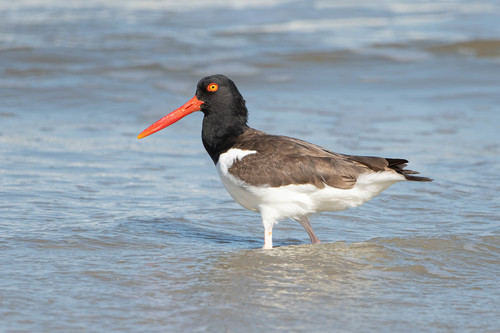
American Oystercatcher
Haematopus palliatus
The American Oystercatcher is the master of the shoreline, equipped with a heavy-duty orange bill designed for the ultimate seafood feast. Watch these bold black-and-white shorebirds patrol the surf with a regal, focused intensity.
Quick Identification
Size
Length: 40-44 cm (16-17.5 in); Wingspan: 76-89 cm (30-35 in); Weight: 400-700 g (0.88-1.54 lbs)
Colors
Jet black head and neck with dark brown back; stark white underparts and wing patches; bright orange-red bill and yellow eyes with a red orbital ring. Males and females are identical in plumage.
Key Features
- Long, heavy, chisel-like bright orange bill
- Large yellow eyes with distinct red-orange rings
- Bold black, white, and brown plumage
- Pale pinkish-grey legs and feet
When You’ll See Them
Geographic range
Where Does the American Oystercatcher Live?
Native to the coastal regions of the Americas, the American Oystercatcher is a fixture of the Atlantic and Gulf Coasts. Its range extends from the Canadian Maritimes down through the Caribbean and along the South American coastline to Argentina and Chile. While they are most concentrated along the Eastern Seaboard of the United States, they also maintain significant populations along the Pacific coast of Mexico and Central America.
Basemap © OpenStreetMap contributors
Behavior
The American Oystercatcher is a charismatic and noisy shorebird, often heard before it is seen. They are famous for their specialized feeding techniques, using their powerful, blade-like bills to either 'stab' the adductor muscle of a partially open mollusk or 'hammer' through the shell of a closed one. This high-level specialization makes them fascinating to watch on camera, as they are one of the few bird species capable of opening heavy-duty bivalves.
Socially, they are often found in pairs or small family groups during the breeding season, though they may gather in larger flocks during the winter months. They are highly territorial when nesting, often engaging in 'piping' displays where they run side-by-side while emitting loud, rhythmic whistling calls to defend their patch of beach. While generally wary of humans, they can become accustomed to predictable activity from a distance.
EverydayEarth exclusive
Camera Tips
Capturing the American Oystercatcher requires a strategic understanding of the tides. Since these birds follow the water line to hunt for exposed shellfish, place your camera in the intertidal zone during low tide. Look for exposed oyster reefs or shell banks—these are their primary 'kitchens.' Ensure your camera housing is salt-resistant and securely anchored, as the incoming tide can be powerful and corrosive.
For the most dramatic footage, set your camera at a very low angle, roughly 6-12 inches off the ground. This 'worm's-eye view' captures the bird's striking orange bill and yellow eyes against the horizon, making for a much more professional look than a high-angle shot. Because they are active, fast-moving foragers, use a high-speed trigger or a rapid-fire burst mode (at least 3-5 photos per trigger) to catch the moment they pry open a shell.
Lighting is crucial on the coast. Try to position your camera facing away from the sun (North or South) to avoid the harsh midday glare reflecting off the sand or water. The 'Golden Hour' just after sunrise or before sunset provides the best color saturation for their orange bills. If your camera allows for interval shooting, set it to take a photo every 30 seconds during the two hours surrounding low tide, as this is when the birds are most likely to linger in one spot to feed.
Similar Species
Species that look similar or are commonly confused with American Oystercatcher.
Frequently Asked Questions
Record American Oystercatcher at your habitat
Connect a camera to start building your own species record — AI identifies every visitor automatically.