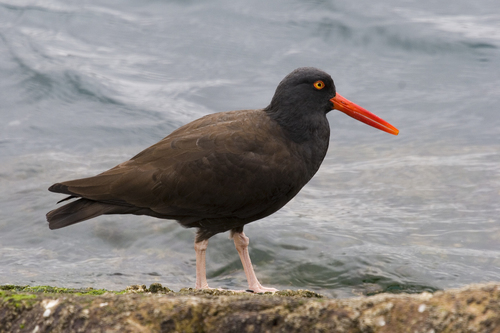
Black Oystercatcher
Haematopus bachmani
With its coal-black feathers and brilliant crimson beak, the Black Oystercatcher is the unmistakable sentinel of the Pacific's rocky shores. A master of the intertidal zone, this hardy bird thrives where the land meets the crashing surf.
Quick Identification
Size
Length: 42–47 cm (17–19 in); Wingspan: 72–91 cm (28–36 in); Weight: 500–700 g (1.1–1.5 lbs)
Colors
Entirely sooty black or dark brown plumage; long, bright red-orange bill; yellow iris with a fleshy red ring; pale pink legs and feet.
Key Features
- Long, heavy, straight red-orange bill
- Bright yellow eyes with fleshy red eye-rings
- Entirely black or dark charcoal plumage
- Pale pinkish legs and large feet
- Loud, piercing whistling calls
When You’ll See Them
Geographic range
Where Does the Black Oystercatcher Live?
This striking shorebird is a permanent resident of the western coastline of North America. Its native range begins in the rugged Aleutian Islands of Alaska and extends south through the fjords of British Columbia and the Pacific Northwest, continuing down to the rocky shores of the Baja California peninsula in Mexico. Unlike many other shorebirds that migrate thousands of miles, the Black Oystercatcher is a homebody, rarely straying far from the narrow strip of Pacific shoreline where it was born.
Basemap © OpenStreetMap contributors
Behavior
The Black Oystercatcher is the quintessential sentinel of the rocky Pacific coast. Highly vocal and deeply territorial, these birds are often heard before they are seen, emitting loud, piping whistles to announce their presence or warn off intruders. They live in pairs year-round, defending specific stretches of shoreline where they forage during low tide. Because they are restricted to a narrow ribbon of coastal habitat, they are highly sensitive to human disturbance and serve as an important indicator species for the health of the intertidal ecosystem.
Their foraging behavior is a masterclass in specialization. Using their knife-like bills, they either hammer through the shells of mussels or skillfully snip the adductor muscles of limpets to pry them off rocks. While they are primarily active during the day, their schedule is dictated more by the moon than the sun; they are most active during the hours of low tide, regardless of whether that falls at dawn, dusk, or midday.
EverydayEarth exclusive
Camera Tips
Capturing a Black Oystercatcher on camera requires an understanding of the tides. Position your camera during low tide in areas where you see clusters of mussel beds or limpet-covered rocks. Because these birds are ground-nesters and ground-foragers, a low camera angle—roughly 12 to 18 inches off the ground—will provide the most intimate and dramatic shots of them prying open shells. Ensure your camera is securely mounted to a heavy rock or a weighted tripod, as the Pacific surf can be unpredictable.
Salt spray is the biggest enemy of your equipment in this environment. Use a high-quality protective housing or a waterproof camera skin, and regularly wipe the lens with a microfiber cloth to prevent salt crusting. If your camera allows for it, set a fast shutter speed; these birds move their heads rapidly when hammering at shells, and you’ll want to freeze that action. Avoid using baits or lures, as these birds only hunt live, fresh marine life and are protected under the Migratory Bird Treaty Act.
For the best lighting, aim for the golden hours of early morning or late afternoon when the low-angle sun hits their bright red bills and yellow eyes, making them pop against their dark plumage. If you are monitoring a nesting site, maintain a significant distance. These birds are extremely wary and will abandon their nests if they feel a camera or person is too close. Use a long focal length or a high-resolution sensor that allows for cropping to respect their space.
Similar Species
Species that look similar or are commonly confused with Black Oystercatcher.
American Oystercatcher
Has a white belly and white wing patches, whereas the Black Oystercatcher is entirely dark.
Black Turnstone
Much smaller with a short, dark bill and white markings on the wings and tail visible during flight.
Surfbird
Smaller and grayer with a shorter, yellowish-based bill and yellow legs.
Frequently Asked Questions
Record Black Oystercatcher at your habitat
Connect a camera to start building your own species record — AI identifies every visitor automatically.