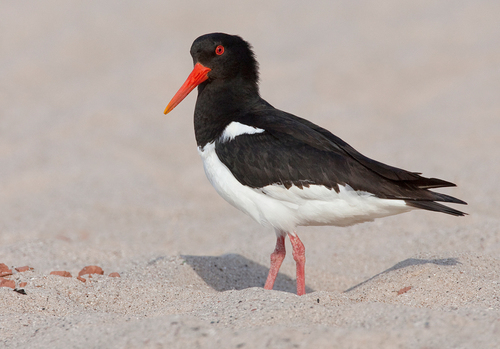
Eurasian Oystercatcher
Haematopus ostralegus
With its neon-orange bill and dapper black-and-white tuxedo, the Eurasian Oystercatcher is a bold and noisy highlight of the shoreline. Whether prying open shellfish or defending its territory with a loud 'piping' dance, this bird is a master of adaptation.
Quick Identification
Size
Length 40–45 cm (16–18 in), wingspan 80–86 cm (31–34 in), weight 425–820 g (0.9–1.8 lbs)
Colors
Jet-black upperparts and head with a stark white underbelly; bright orange-red bill and red eyes. Females typically have slightly longer bills than males.
Key Features
- Long, straight orange-red bill
- Striking black and white 'pied' plumage
- Thick, dull pink legs
- Distinctive red eye-ring
- Loud, piercing 'kleep' call
When You’ll See Them
Geographic range
Where Does the Eurasian Oystercatcher Live?
Native across the vast Palearctic region, the Eurasian Oystercatcher is a fixture of the coastlines of Europe and Asia. Its core range spans from the rocky shores of Iceland and the British Isles across the North Sea and Baltic coasts to the Russian Far East. While many populations are resident in Western Europe year-round, northern and eastern populations migrate south to the Mediterranean, North Africa, and Southern Asia during the winter months.
Basemap © OpenStreetMap contributors
Behavior
The Eurasian Oystercatcher is one of the most vocal and charismatic waders you will encounter. Known for their high-pitched, shrill calls, they are often heard long before they are seen. They are highly social outside of the breeding season, forming large, noisy flocks on estuaries and mudflats. Their social structure is fascinating; they are famous for their 'piping ceremonies,' where groups of birds run together with bills pointed downward, uttering a rhythmic series of loud notes to establish territory or social dominance.
One of the most remarkable aspects of their behavior is their specialized feeding technique. Individuals are usually 'specialists,' having learned from their parents either to hammer through the shells of mussels and cockles or to skillfully pry them open with their blade-like bills. While traditionally coastal birds, many have adapted to inland life, nesting on gravel rooftops, in agricultural fields, or along riverbanks, showing a surprising level of tolerance for human-altered landscapes.
EverydayEarth exclusive
Camera Tips
To capture high-quality footage of a Eurasian Oystercatcher, your camera placement should be exceptionally low. These birds spend almost all their time on the ground; setting your camera just 15-20 centimeters off the deck will provide a stunning 'eye-level' perspective that makes for much more engaging content than a top-down view. If you are in a suburban area near a river or coast, look for open patches of short grass or gravel where they might probe for worms.
Because Oystercatchers are very wary of movement, camouflage is your best friend. Use a camera with a matte finish or a camo-wrap, and tuck it near a natural feature like a large stone or a clump of beach grass. They are attracted to wide-open spaces with good visibility, so don't place your camera in thick brush. If you have a large backyard, a very shallow, ground-level water basin can be a major draw, especially in the heat of summer.
These birds follow the tides rather than the sun, meaning they are frequently active at night. Ensure your camera's infrared flash is powerful enough to illuminate at least 10 meters, as they may forage in the middle of a field or shore away from the lens. Set your camera to take short video clips (15-20 seconds) with a fast trigger speed; their 'piping' displays are fast-moving and vocal, and video is the only way to truly capture the energy of their social interactions.
Similar Species
Species that look similar or are commonly confused with Eurasian Oystercatcher.
American Oystercatcher
Found in the Americas; has a yellow eye-ring and a slightly different wing pattern compared to the Eurasian species.
Pied Avocet
Also black and white, but has a thin, upward-curved bill and much longer, blue-grey legs.
Magpie
While similarly colored, the Magpie is a songbird with a long tail and a short, thick black bill, found in trees rather than on the ground near water.
Frequently Asked Questions
Record Eurasian Oystercatcher at your habitat
Connect a camera to start building your own species record — AI identifies every visitor automatically.