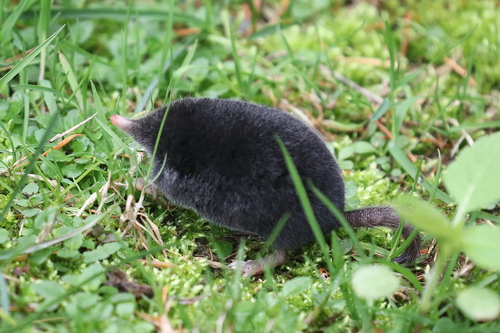
American Shrewmole
Neurotrichus gibbsii
The American Shrew-mole is a fascinating evolutionary 'in-between,' possessing the velvet fur of a mole and the energetic spirit of a shrew. As the smallest mole in the world, this elusive Pacific Northwest native is a master of the forest floor's hidden world.
Quick Identification
Size
Total length of 10-12.5 cm (4-5 in); weight of 9-11 grams (0.3-0.4 oz)
Colors
Uniform dark gray to sooty black fur with a slight silvery sheen; pale pinkish-gray feet and tail
Key Features
- Smallest North American mole
- Long, flattened snout with prominent whiskers
- Thick, hairy tail making up 1/3 of body length
- Broad front paws that are less 'turned out' than larger moles
When You’ll See Them
Geographic range
Where Does the American Shrewmole Live?
The American Shrew-mole is a native resident of the Pacific Northwest region of North America. Its core range spans from south-central British Columbia in Canada, southward through the coastal regions of Washington and Oregon, and reaching as far south as central California. This species is almost exclusively found west of the Cascade and Sierra Nevada mountain ranges, thriving in the humid, temperate maritime climate of the Pacific coast.
Basemap © OpenStreetMap contributors
Behavior
Unlike their larger cousins who spend almost their entire lives in deep tunnels, the American Shrew-mole is surprisingly agile and frequently ventures onto the forest floor. They are highly active creatures that cycle through short bursts of intense activity and rest throughout the day and night. Interestingly, they are more social than most moles and are often found traveling in small, loose groups while foraging through the leaf litter.
These tiny mammals are also capable climbers and swimmers, occasionally scaling low-lying shrubs or crossing small streams in search of food. While they do dig shallow tunnels, they often utilize the abandoned runways of other small mammals like voles or shrews. When interacting with humans or larger animals, they are rarely seen due to their size and speed, but they play a vital role in aerating forest soils and controlling insect populations.
EverydayEarth exclusive
Camera Tips
Capturing the American Shrew-mole on camera requires a specialized approach because of their diminutive size and fast-paced movement. Since they are the smallest mole species, standard trail cameras placed at deer-height will completely miss them. You must position your camera at 'ground-zero,' ideally just 2-3 inches off the forest floor. Using a camera with a macro lens or a very short minimum focus distance is essential; otherwise, the shrew-mole will appear as a blurry dark blob.
Target damp, shady microhabitats in your yard or local woodland. Look for areas with thick mulch, decaying logs, or moist leaf litter where they forage for earthworms. Because they often use existing 'runways' or tunnels just beneath the surface, placing your camera along a natural log or a stone edge can act as a funnel to guide them directly in front of the lens. Use the highest sensitivity setting on your PIR sensor, as their tiny body mass may not always trigger less sensitive sensors.
While they don't respond to typical bird seed, you can sometimes attract them by lightly disturbing the soil to expose fresh earthworms or by placing a very small amount of wet cat food or mealworms in a shallow depression. Set your camera to take rapid-fire bursts or high-frame-rate video, as these animals move with a nervous, twitchy energy. In many cases, you will catch them darting in and out of the leaf litter in a fraction of a second, so a fast trigger speed is your best friend.
Similar Species
Species that look similar or are commonly confused with American Shrewmole.
Vagrant Shrew
Much thinner front paws and a more pointed, needle-like snout; lacks the broad digging hands of the mole.
Coast Mole
Significantly larger (about double the size) with massive, outward-facing pink claws designed for heavy digging.
Townsend's Mole
Much larger and darker fur; unlike the shrew-mole, it rarely ventures above ground and lacks a hairy tail.
Frequently Asked Questions
Record American Shrewmole at your habitat
Connect a camera to start building your own species record — AI identifies every visitor automatically.