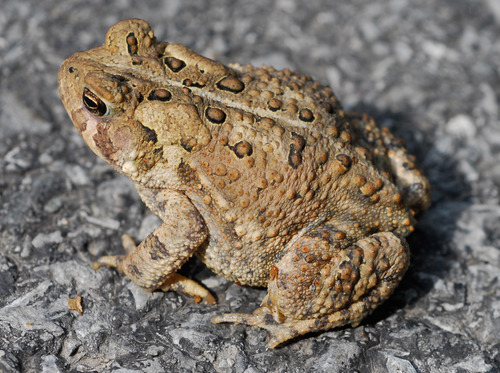
American Toad
Anaxyrus americanus
The American Toad is a resilient and beneficial garden companion known for its musical spring trill and voracious appetite for pests. These bumpy-skinned amphibians are masters of camouflage, making them a rewarding discovery for any backyard wildlife enthusiast.
Quick Identification
Size
2 to 3.5 inches (5 to 9 cm) in length; weight typically 20 to 50 grams
Colors
Earthy tones of brown, gray, or olive with dark spots; bellies are usually light-colored with dark speckling
Key Features
- 1-2 warts per dark dorsal spot
- Cranial crests do not touch the parotoid glands
- Light-colored line often runs down the center of the back
- Large, kidney-shaped parotoid glands behind the eyes
When You’ll See Them
Geographic range
Where Does the American Toad Live?
Native to the North American continent, the American Toad is a staple of the eastern landscape. Its core range stretches from the Canadian provinces of Ontario and Quebec down through the eastern United States, reaching as far south as Georgia and westward to the eastern edges of the Great Plains. While they thrive in the humid forests of the Northeast, they have also successfully colonized suburban environments across the Midwest and Atlantic coast, making them one of the most widely recognized amphibians in the region.
Basemap © OpenStreetMap contributors
Behavior
American Toads are primarily solitary and nocturnal, spending their days hiding under logs, stones, or leaf litter to stay moist. Unlike many frogs that rely on long leaps, toads move with short, awkward hops or a slow crawl. They are most famous for their incredible spring choruses, where males produce a long, musical trill that can last up to 30 seconds to attract mates.
These amphibians are remarkably resilient and exhibit high site fidelity, often returning to the same garden or breeding pond year after year. When threatened, they don't just rely on camouflage; they puff up their bodies to look larger and secrete a mild toxin called bufotoxin from their skin. This makes them unpalatable to most backyard predators like dogs or cats, though they are perfectly safe to observe from a distance.
EverydayEarth exclusive
Camera Tips
To capture the American Toad on a backyard camera, you must think low. These amphibians rarely leave the ground, so place your camera just 3 to 5 inches above the soil. Position it near garden edges, mulch piles, or under dense foliage where they like to hunt for insects. A wide-angle lens with a close-focus capability is essential, as the toad needs to be relatively close to the sensor to trigger the motion PIR and fill the frame.
Water is the ultimate lure for a toad. Setting up your camera near a shallow pond, a dripping hose, or even a specialized 'toad abode' (a ceramic pot turned on its side in a damp area) will yield the best results. Because they are most active at night, ensure your camera has a high-quality infrared flash. Be careful with flash intensity; because a toad's skin is moist and reflective, it can easily 'white out' in photos if the flash is too powerful at close range.
For the most engaging footage, use 'Video' or 'Burst' mode. This allows you to witness their unique hunting style—a 'sit and wait' approach followed by a lightning-fast tongue flick. If you are recording in the spring, the audio is just as important as the video. Ensure your camera's microphone is enabled to capture the iconic, high-pitched trills that define the American Toad's breeding season.
Similar Species
Species that look similar or are commonly confused with American Toad.
Frequently Asked Questions
Record American Toad at your habitat
Connect a camera to start building your own species record — AI identifies every visitor automatically.