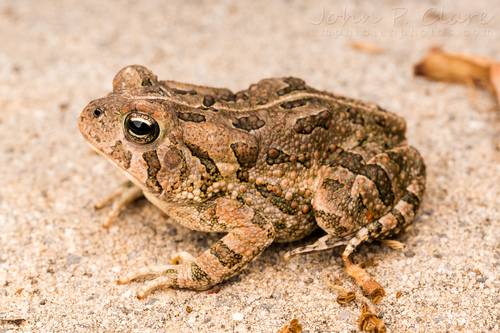
Fowler's Toad
Anaxyrus fowleri
The nocturnal sentinel of the garden, the Fowler's Toad is a master of camouflage and a champion insect-hunter. Listen for its unique sheep-like call on warm, humid nights.
Quick Identification
Size
2 to 3.5 inches (5 to 9 cm) in length; weight is typically under 2 ounces (50g)
Colors
Earthy tones ranging from brownish-grey to olive green with a pale white or cream-colored underside. Features dark spots on the back containing three or more warts.
Key Features
- 3 or more warts per dark dorsal spot
- Parotoid glands touch the cranial crests
- Pale, unspotted belly with a single dark chest spot occasionally present
- Light-colored stripe running down the center of the back
When You’ll See Them
Behavior
Fowler's Toads are fascinating, high-energy amphibians that are frequently encountered in residential gardens and sandy coastal areas. Unlike many other toad species that prefer the deep dampness of a forest floor, these toads are quite comfortable in open, drier environments where they can burrow into loose soil during the day to stay cool. They are most famous for their defensive strategy; when threatened, they can puff themselves up with air to appear larger or secrete a bitter-tasting toxin from their parotoid glands that discourages predators like raccoons and snakes.
During the spring and summer breeding seasons, males congregate near shallow water and produce a very distinct call—a loud, nasal bleat that sounds remarkably like a distressed sheep. They are solitary hunters for the rest of the year, spending their nights patrolling backyards for a variety of insects. While they are generally shy around humans, they are highly beneficial to have around as they act as a natural pest control system, consuming hundreds of beetles and ants over a single season.
EverydayEarth exclusive
Camera Tips
Capturing high-quality footage of a Fowler's Toad requires getting your camera down to their level. These toads rarely climb, so a camera mounted at eye level will miss them entirely. For the best results, position your camera just 2 to 4 inches off the ground. If you are using a trail camera with a mounting strap, try securing it to a low-lying brick or a small stake in the garden. Angle the lens slightly downward to ensure you capture the top of the toad's head and back, which is essential for identifying those characteristic 'three-wart' spots.
Lighting is your biggest hurdle since Fowler's Toads are strictly nocturnal and usually only emerge after dark. We recommend using a camera with a 'No-Glow' or 'Black Flash' infrared system. While 'Low-Glow' LEDs are often fine for mammals, amphibians can sometimes be sensitive to the faint red glow. To increase your chances of a sighting, place your camera near a low-intensity outdoor light source—not because the toad likes the light, but because the light attracts the moths and beetles that the toad likes to eat. This creates a natural 'buffet' that will keep the toad in the camera's frame for a longer duration.
You can create a 'toad stage' to guarantee better shots. Place an overturned ceramic pot (a 'toad abode') or a flat rock in a damp area of your yard and aim the camera at the entrance. Toads are creatures of habit and will often return to the same burrow night after night. If the weather has been dry, lightly misting the area with a garden hose in the evening can trigger activity, as they are much more likely to emerge and hunt when there is moisture in the air.
Finally, adjust your camera settings to capture video rather than just still photos. A Fowler's Toad can sit perfectly motionless for minutes at a time, making it look like a rock in a still image. A 15-second video clip is much more likely to capture the moment they snap up a passing insect or move with their characteristic hopping gait. If your camera has a sensitive microphone, you might even record the unique 'sheep-bleat' call during the peak of the breeding season in late spring.
Similar Species
Species that look similar or are commonly confused with Fowler's Toad.
Frequently Asked Questions
Record Fowler's Toad at your habitat
Connect a camera to start building your own species record — AI identifies every visitor automatically.