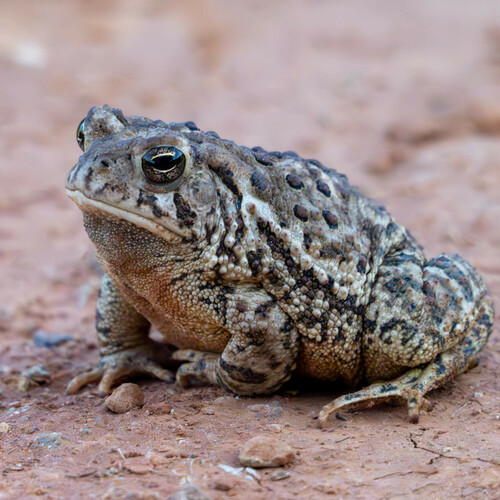
Woodhouse's Toad
Anaxyrus woodhousii
Meet the Woodhouse's Toad, the resilient garden guardian of the American West. With its distinct dorsal stripe and rhythmic evening call, this adaptable amphibian is a master of the night-time hunt and a welcome guest in any backyard.
Quick Identification
Size
2.5 to 4 inches (6.4 to 10 cm) in length; weight typically ranges from 1 to 3 ounces (28 to 85 grams).
Colors
Mottled gray, brown, or olive-green skin with dark, irregular blotches. A prominent white or yellowish stripe runs down the center of the spine. The belly is cream-colored, often featuring a single dark spot on the chest.
Key Features
- Prominent pale dorsal stripe running down the center of the back
- Elongated parotoid glands that touch the L-shaped cranial crests
- Warty skin with dark splotches containing multiple warts
- Pale belly usually featuring a single dark breast spot
When You’ll See Them
Behavior
Woodhouse's Toads are patient, sit-and-wait predators. Unlike some more active hunters, they spend much of their evening sitting perfectly still in areas where insects are likely to congregate. They are well-known for their 'urban' intelligence, often gathering under porch lights or street lamps to feast on the moths and beetles attracted to the glow. During the day, they are master hiders, using their powerful back legs to burrow into loose soil or tucking themselves under logs and leaf litter to stay cool and moist.
Socially, these toads are solitary outside of the breeding season. In the spring, males move toward standing water—from temporary rain pools to suburban ornamental ponds—and emit a distinctive call that sounds like a Sheep's bleat or a high-pitched 'waaaaaah.' While they are generally docile and will simply try to hop away from humans, they do possess parotoid glands behind their eyes that secrete a mild toxin to discourage predators from eating them.
EverydayEarth exclusive
Camera Tips
To capture high-quality footage of a Woodhouse's Toad, you must think low. These amphibians spend their entire lives on or under the ground, so your camera should be mounted no more than 4 to 6 inches off the ground. If you are using a stake mount, angle the lens slightly downward (about 10-15 degrees) toward a flat, clear area where the toad is likely to sit. Because toads are small, ensure your camera's PIR (motion) sensor is sensitive enough to trigger on small movements, or consider using a 'Time Lapse' mode with a 30-second interval during the first few hours of darkness.
The 'secret weapon' for Woodhouse's Toad photography is artificial light. Because these toads have learned that light attracts bugs, they are frequently found on patios, walkways, or near the base of outdoor walls where light spills over. Position your camera facing a well-lit patch of pavement or a light-colored garden stone. The contrast will make the toad's mottled skin patterns pop, and you're much more likely to catch them in the middle of a strike as they lunge for a moth. If you are in a darker area, look for 'toad highways'—the damp edges of flower beds or the space where a lawn meets a concrete path.
Seasonal timing is critical for 'action' shots. The best time to deploy your camera is immediately following a heavy spring or summer rain. The increase in humidity and the emergence of insects triggers a massive surge in toad activity. If you have a small water feature or even a shallow dish of water in your yard, place the camera nearby; Woodhouse's Toads don't drink water through their mouths but absorb it through a 'pelvic patch' on their bellies, making a shallow water source an irresistible pit stop. Set your camera to 'Hybrid Mode' (photo + video) if available, as a still photo captures their intricate textures while video captures their unique 'sheep-like' vocalizations during the breeding months.
Similar Species
Species that look similar or are commonly confused with Woodhouse's Toad.
Frequently Asked Questions
Record Woodhouse's Toad at your habitat
Connect a camera to start building your own species record — AI identifies every visitor automatically.