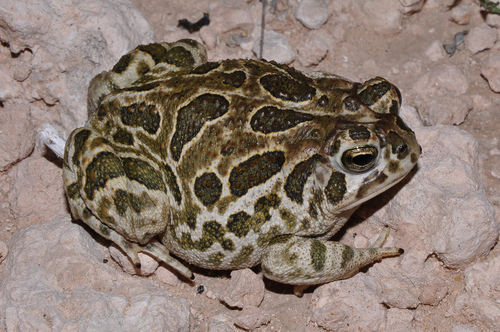
Great Plains Toad
Anaxyrus cognatus
The Great Plains Toad is the ultimate backyard survivor, hiding beneath the soil until the summer rains call it to the surface. With its beautiful 'camouflage' blotches and booming voice, it is a rewarding species to track on your night camera.
Quick Identification
Size
2 to 4.5 inches (5.1 to 11.4 cm) in length; typically weighs 1 to 3 ounces (28 to 85 g)
Colors
Base color ranges from gray to olive or tan with large, dark, symmetrical blotches outlined in white or pale yellow. The underside is creamy white and usually lacks spots.
Key Features
- Distinctive paired dark blotches on the back with light borders
- Cranial crests that meet in a sharp V-shape between the eyes and snout
- Large, kidney-shaped parotoid glands behind the eyes
- Dry, warty skin and a stocky, rounded body
When You’ll See Them
Behavior
The Great Plains Toad is a master of patience and survival in semi-arid environments. Unlike many amphibians that stay near permanent water, this species spends much of its life underground. They are expert burrowers, using their spade-like hind feet to retreat into the soil to escape the daytime heat or the freezing temperatures of winter. This fossorial lifestyle means they are rarely seen during dry spells, making their sudden appearance during summer storms all the more dramatic.
When the heavy rains arrive, usually in late spring or summer, these toads emerge in massive numbers for "explosive" breeding events. Males head to temporary pools or flooded fields and produce a loud, mechanical trill that can last for up to 50 seconds. While they are generally solitary and docile, their persistence during mating season is remarkable. For the backyard observer, they are beneficial neighbors that remain relatively stationary while hunting, often returning to the same "home" burrow or sheltered garden spot night after night.
EverydayEarth exclusive
Camera Tips
To capture the Great Plains Toad, you must get your camera low. These are ground-dwelling creatures that rarely rise more than an inch or two off the dirt. For the best results, mount your camera just 3–5 inches above the ground. If your camera allows for it, use a slight upward tilt (about 5-10 degrees) to capture the detail of their throat during a call or the unique patterns on their back. Placing the camera too high will result in a distorted "bird's-eye view" that misses their distinctive facial features.
One of the most effective ways to lure a Great Plains Toad into your camera’s field of view is to exploit their diet. They are highly attracted to areas where insects congregate. Position your camera near a low-voltage garden light or a porch light that stays on after dark. The light attracts moths and beetles, which in turn creates a buffet for the toad. If you don't have a light source, placing your camera near a damp area of the garden or a recently watered flower bed will increase your chances, as these toads seek out moisture to keep their skin hydrated.
Timing is everything with this species. If your area has just experienced a heavy summer downpour or a significant irrigation event, that is the prime time to check your camera. Set your PIR (Passive Infrared) sensor to the highest sensitivity. Because toads are cold-blooded and move relatively slowly, they can sometimes fail to trigger sensors designed for larger, warmer mammals. A high sensitivity setting ensures the camera picks up their movement as they hop across the frame.
Finally, consider your camera's "Photo Burst" or "Hybrid" mode. Since a toad might sit perfectly still for several minutes waiting for a bug, a single photo might miss the action. Setting the camera to take 3–5 photos per trigger, or a short 10-second video clip, will allow you to see the incredible speed of their tongue during a strike. If you are filming, ensure your night-vision LEDs are set to 'Power Save' or 'Medium' if the toad is very close to the lens, otherwise, their light-colored belly may appear overexposed and "blown out" in the footage.
Similar Species
Species that look similar or are commonly confused with Great Plains Toad.
Woodhouse's Toad
Woodhouse's toads have a prominent light-colored line running down the middle of the back and more random, smaller spots rather than large paired blotches.
American Toad
American toads usually have only one or two warts per dark spot, whereas Great Plains toads have many warts within their large, pale-bordered blotches.
Green Toad
Much smaller in size, with a flatter body and a distinct bright green or yellowish coloration with small black spots.
Frequently Asked Questions
Record Great Plains Toad at your habitat
Connect a camera to start building your own species record — AI identifies every visitor automatically.