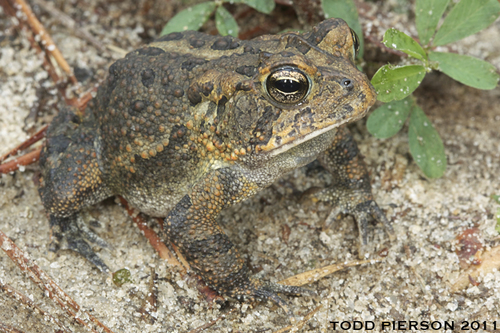
Southern Toad
Anaxyrus terrestris
The Southern Toad is a charming and helpful garden guest, easily identified by the distinct knobs on its head. These nocturnal hunters are the ultimate natural pest control for backyards across the American South.
Quick Identification
Size
1.6 to 3.6 inches (4 to 9 cm) in length; females are generally larger than males.
Colors
Varied shades of brown, gray, or reddish-brick; often featuring dark spots and a light stripe down the center of the back.
Key Features
- Prominent cranial crests with high, knob-like swellings behind the eyes
- Dry, warty skin with varying dark blotches
- Large, oval parotoid glands behind the eyes
- Horizontal pupils and stocky build
When You’ll See Them
Behavior
The Southern Toad is a quintessential nocturnal resident of the Southeast. During the day, it is a master of concealment, using its powerful hind legs to burrow into sandy soil or hiding beneath leaf litter and fallen logs to stay cool and moist. They are generally solitary creatures, only congregating in large numbers during the breeding season around shallow wetlands or temporary pools.
In suburban environments, these toads have adapted remarkably well to human presence. They are frequently seen on porches and sidewalks at night, having learned that outdoor lights attract a buffet of moths and beetles. While they are docile and will usually hop away if approached, they can secrete a mild toxin from their parotoid glands as a defense mechanism if a predator—or a curious pet—tries to take a bite.
EverydayEarth exclusive
Camera Tips
To capture the Southern Toad on camera, ground-level placement is non-negotiable. Mount your camera no more than 3 to 5 inches off the ground, or simply prop it up on a flat stone. Position the lens to look across a flat area of soil, mulch, or a paved walkway where the toad’s silhouette will stand out clearly against the background. Using a wide-angle lens setting is helpful, as these toads often hop closer to the camera than expected.
Our best 'pro tip' for Southern Toads is to leverage artificial light. Position your camera near a low-voltage garden light or a porch light. These toads are highly intelligent foragers and will regularly return to the same illuminated 'hunting grounds' night after night because they know the light acts as a natural insect trap. By aiming your camera at the pool of light on the ground, you are almost guaranteed to catch them in action.
Humidity is your best friend when timing your captures. While you might see them on any warm night, their activity levels skyrocket during and immediately after a summer rainstorm. The moisture encourages them to leave their burrows to rehydrate and hunt. If your camera has a 'time-lapse' mode, try setting it to trigger every 1-2 minutes during a rainy evening to see them migrating across your yard.
Regarding settings, utilize a high-sensitivity PIR (Passive Infrared) sensor setting if available, as the cold-blooded nature of the toad can sometimes make them harder to trigger than a warm mammal. A short video clip (5-10 seconds) is often more rewarding than a still photo, as it allows you to see their unique 'hopping' gait and the lightning-fast flick of their tongue as they snatch up prey.
Similar Species
Species that look similar or are commonly confused with Southern Toad.
American Toad
The American Toad lacks the high, knob-like swellings on the cranial crests that are characteristic of the Southern Toad.
Fowler's Toad
Fowler's Toads have three or more warts inside each dark dorsal spot, while Southern Toads usually have only one or two.
Oak Toad
The Oak Toad is much smaller (under 1.75 inches) and has a very bright, distinct yellow or orange stripe down its back.
Frequently Asked Questions
Record Southern Toad at your habitat
Connect a camera to start building your own species record — AI identifies every visitor automatically.