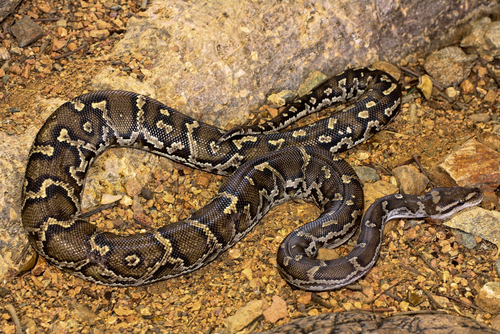
Anchieta's Dwarf Python
Python anchietae
A rare and stunning inhabitant of the African escarpment, the Anchieta’s Dwarf Python is a master of rocky camouflage. Known for its docile nature and beautiful beaded scales, this elusive snake is a true prize for any wildlife observer.
Quick Identification
Size
Typically ranges from 1 to 1.3 metres (3.3 to 4.3 feet) in length, with a thick, muscular girth.
Colors
Rich reddish-brown to chocolate brown base color, featuring cream or white circular spots and bands outlined in bold black.
Key Features
- Distinct triangular head with heat-sensing pits along the upper lip
- Bead-like scales that give the skin a pebbled texture
- White or cream dorsal spots with thick black borders
- Stout, heavy-bodied build with a short tail
When You’ll See Them
Geographic range
Where Does the Anchieta's Dwarf Python Live?
Native to the southwestern corner of the African continent, the Anchieta’s Dwarf Python occupies a relatively narrow and specialized range. This species is primarily found in the rugged, arid landscapes of southern Angola and northern to central Namibia. It is a specialist of the rocky outcrops and scrubby deserts of the Namibian escarpment, making it a localized resident of the Kaokoveld and Damaraland regions. There are no known introduced populations outside of its native southern African range.
Basemap © OpenStreetMap contributors
Behavior
Anchieta's Dwarf Python is a primarily nocturnal and crepuscular hunter, spending the heat of the day tucked away in rocky crevices or abandoned mammal burrows. Despite being a python, it is famously docile and rarely shows aggression toward humans, often choosing to curl into a tight ball as a defense mechanism—a trait it shares with its close relative, the Ball Python. This species is well-adapted to arid environments, where its beaded scales may help reduce water loss.
In the wild, these pythons are solitary creatures. They are terrestrial by nature but are capable climbers when searching for bird nests or escaping predators. Because they live in remote, rugged terrain, they have infrequent interactions with people, making them one of the more 'mysterious' python species for researchers and enthusiasts alike.
EverydayEarth exclusive
Camera Tips
To capture an Anchieta's Dwarf Python on camera, you must focus on 'micro-habitats.' These snakes are rarely found in open plains; instead, place your camera near the base of large rocky outcrops or 'kopjes.' Look for narrow crevices or caves that show signs of animal traffic. Positioning the camera low to the ground—about 6 to 12 inches high—is essential for getting a clear view of their intricate scale patterns and heat pits.
Since these pythons are strictly nocturnal, a camera with high-quality infrared (no-glow) LEDs is a must. Standard white flash might startle the snake or cause overexposed 'white-out' on their reflective scales. Set your camera to take short video clips (10-15 seconds) rather than just stills; pythons move slowly and deliberately, and a video provides a much better chance of seeing their tongue-flicking behavior and hunting posture.
If you are monitoring a private property or a trail, look for areas where prey species like rock hyraxes are active. Anchieta's Dwarf Pythons often frequent these 'high-traffic' rodent zones. Avoid using artificial baits, as these snakes respond primarily to heat and movement. Instead, focus on natural pinch points between rocks where a snake might travel under the cover of darkness. In cooler months, they may occasionally bask near crevice entrances in the early morning, so a camera set to time-lapse mode during the first two hours of sunrise can sometimes yield surprising results.
Similar Species
Species that look similar or are commonly confused with Anchieta's Dwarf Python.
Frequently Asked Questions
Record Anchieta's Dwarf Python at your habitat
Connect a camera to start building your own species record — AI identifies every visitor automatically.