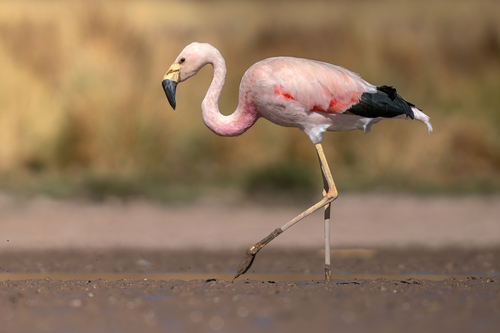
Andean Flamingo
Phoenicoparrus andinus
The Andean Flamingo is a master of survival, thriving in the thin air and salty lagoons of the high Andes. Easily identified by its unique yellow legs, this rare bird is a stunning symbol of South America's alpine wilderness.
Quick Identification
Size
Height: 102-110 cm (40-43 in); Wingspan: 1-1.6 m (3.3-5.2 ft); Weight: 2-2.4 kg (4.4-5.3 lbs)
Colors
Pale pink body with deep wine-red streaks on the neck and breast; distinctive bright yellow legs and feet; beak is yellow at the base with a prominent black tip.
Key Features
- Bright yellow legs and feet unique to this species
- Large black 'triangle' visible on the rear when wings are folded
- Deep pink or wine-colored plumage on the upper breast
- Yellow-based bill with a large black tip
When You’ll See Them
Geographic range
Where Does the Andean Flamingo Live?
Native to the rugged high-altitude plateaus of the South American Andes, this elegant bird calls the 'Lithium Triangle' its primary home. The core of its range is found in the salt flats and wetlands of northern Chile, southwestern Bolivia, and northwestern Argentina. Some populations also extend into southern Peru, following the high-altitude wetlands where food is most abundant during the breeding season. While they are specialists of the heights, they occasionally descend to lower-altitude wetlands in search of open water during particularly harsh winters.
Basemap © OpenStreetMap contributors
Behavior
Andean Flamingos are highly social birds that spend most of their lives in large, noisy colonies. They are famous for their synchronized group displays, which involve 'marching' and rhythmic head-turning to attract mates. Despite their delicate appearance, they are incredibly hardy, living in some of the harshest, highest-altitude environments on the planet where temperatures can drop below freezing nightly.
These birds are specialized filter feeders. They can often be seen performing a 'feeding dance,' where they spin in circles or stomp their feet in the mud to stir up the microscopic organisms they eat. While they are generally wary of humans, they are nomadic and will travel long distances between different salt lakes (salars) in search of the best feeding or breeding conditions, often moving in V-shaped formations through the thin mountain air.
EverydayEarth exclusive
Camera Tips
Capturing the Andean Flamingo on camera requires a specialized approach due to their extreme habitats. If you are setting up a trail camera near a high-altitude lagoon, the most important factor is protection from the elements. Use a rugged, weather-sealed camera housing to protect against intense UV radiation and the corrosive nature of the salty spray from the lakes. Because the Altiplano is often cloudless, you may need to adjust your camera's exposure settings or use a polarizing filter to prevent the bright white salt flats from 'blowing out' the image.
Position your camera at a low angle, roughly 12-18 inches off the ground, near the shallow edges where the flamingos congregate to feed. These birds are sensitive to movement, so a well-camouflaged setup is essential. Since they often travel in large groups, consider using a wider-angle lens setting to capture the scale of the colony rather than just a single individual. Setting your camera to 'Burst Mode' is highly recommended to capture their fast-paced feeding dances or the moment they take flight.
Battery life is a major challenge in the cold Andean nights. Even if the days are sunny, temperatures plummet after sunset, which can drain standard batteries in hours. Using high-quality lithium batteries or an external solar panel power kit is non-negotiable for long-term deployments. If you are using a camera with motion sensors, be aware that the shimmering heat waves off the salt flats or the movement of wind-blown water can sometimes cause false triggers; adjusting the PIR (Passive Infrared) sensitivity to 'Medium' or 'Low' can help conserve storage space.
Similar Species
Species that look similar or are commonly confused with Andean Flamingo.
Frequently Asked Questions
Record Andean Flamingo at your habitat
Connect a camera to start building your own species record — AI identifies every visitor automatically.