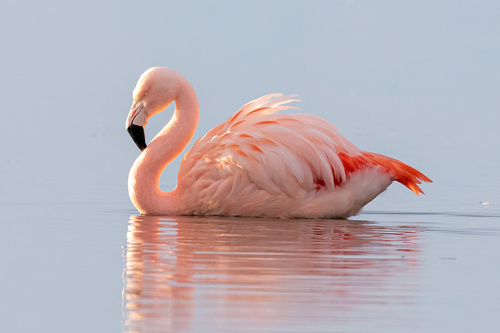
Chilean Flamingo
Phoenicopterus chilensis
The Chilean Flamingo is the socialite of the South American wetlands, recognizable by its unique 'pink knees' and synchronized group dances. From the high-altitude salt flats of the Andes to the Atlantic coast, these resilient birds bring a splash of salmon-colored elegance to the most rugged landscapes.
Quick Identification
Size
110–130 cm (43–51 in) tall; 120–150 cm (47–59 in) wingspan; 2.5–3.5 kg (5.5–7.7 lbs)
Colors
Pale pink to salmon-colored plumage with black primary flight feathers; greyish-blue legs with distinctive pink ankles (knees) and feet.
Key Features
- Grey legs with bright pink joints and feet
- Bill is more than half black from the tip
- Lighter pink plumage than the American Flamingo
- Large, downward-curved filter-feeding bill
When You’ll See Them
Geographic range
Where Does the Chilean Flamingo Live?
Native to the southern half of South America, the Chilean Flamingo occupies a vast geographic range stretching from central Peru and southern Brazil down through the Andes to Tierra del Fuego. These birds are common across the salt flats of the Altiplano in Bolivia and northern Chile, but they also maintain a strong presence in the lowland wetlands of Argentina and Uruguay. While primarily a South American species, occasional vagrants or escapees from collections are sometimes spotted in North America and Europe, though these do not represent established wild populations.
Basemap © OpenStreetMap contributors
Behavior
Chilean Flamingos are highly social birds that thrive in vast colonies, sometimes numbering in the thousands. Their daily lives revolve around complex social structures and highly synchronized group displays. During the breeding season, they perform elaborate "dances" where hundreds of birds march together, stretching their necks and snapping their wings open to reveal the dark flight feathers beneath. These displays are crucial for pair bonding and colony coordination.
While they appear delicate, these flamingos are surprisingly hardy, capable of enduring the harsh, alkaline environments of the high Andes. They spend a significant portion of their day with their heads submerged or sweeping through the water, filter-feeding in a distinctive rhythmic motion. In interactions with humans, they are generally skittish and will take flight if approached too closely, though birds in protected coastal areas can become somewhat accustomed to distant observers.
EverydayEarth exclusive
Camera Tips
Capturing Chilean Flamingos on a trail camera requires careful consideration of their watery environment. If you live near a coastal lagoon or an inland salt lake where they congregate, place your camera on a sturdy tripod or a weighted mounting post driven into the mud. Aim for a low-angle setup—roughly 12 to 24 inches above the water line—to capture the stunning reflections of their pink plumage and the intricate details of their filter-feeding behavior. Be sure to use a waterproof casing, as tidal changes or wind-driven waves can easily submerge low-lying equipment.
Because flamingos are often at a distance from the shore, choose a camera with a high-quality telephoto lens or a high-resolution sensor that allows for cropping. Motion sensors (PIR) can struggle with the distance and the reflective surface of the water; if your camera supports it, use a 'Time Lapse' mode set to intervals of 1 to 5 minutes during the early morning and late afternoon. This ensures you catch the colony moving through the frame even if they don't trigger the motion sensor. Avoid using bright white flashes at night as it can spook the entire colony; instead, opt for No-Glow infrared flash to capture their nocturnal movements without disturbance.
Pay close attention to the sun's position. For the most vibrant pinks, position your camera with the sun at your back, facing the water. This lighting will make the birds 'pop' against the blue or grey water. In high-altitude Andean environments, battery life can drop significantly due to cold temperatures, so external power packs or high-capacity lithium batteries are essential for long-term monitoring. If you are placing cameras in tidal zones, always check local tide tables to ensure your gear won't be swept away during a high spring tide.
Similar Species
Species that look similar or are commonly confused with Chilean Flamingo.
Frequently Asked Questions
Record Chilean Flamingo at your habitat
Connect a camera to start building your own species record — AI identifies every visitor automatically.