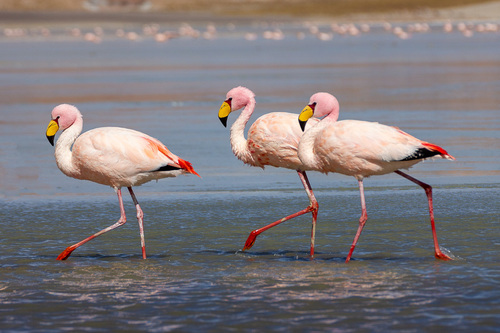
James's Flamingo
Phoenicoparrus jamesi
A high-altitude specialist with striking carmine feathers and a bright yellow bill, James’s Flamingo is a rare jewel of the Andean plateaus. Once thought to be extinct, this resilient bird thrives in some of the harshest, most beautiful salt lakes on Earth.
Quick Identification
Size
Length: 90-92 cm (35-36 in); Wingspan: 100-110 cm (39-43 in); Weight: approx. 2 kg (4.4 lbs)
Colors
Pale pink body with bright carmine-red streaks on the neck and back; black flight feathers; bright yellow bill with a black tip; brick-red legs and a red patch of skin around the eyes.
Key Features
- Distinctive yellow bill with a small black tip
- Bright red skin patch (lores) between the eye and bill
- Brick-red legs and three-toed feet
- Pale pink plumage with deep carmine highlights
When You’ll See Them
Geographic range
Where Does the James's Flamingo Live?
James's Flamingo is a high-altitude specialist native to the South American Andes. Its primary range is concentrated in the Altiplano regions of southwestern Bolivia, northern Chile, northwestern Argentina, and southern Peru. These birds are restricted to specific salt lake ecosystems, often found at elevations exceeding 3,500 meters, where they migrate nomadically between lagoons in search of optimal feeding conditions.
Basemap © OpenStreetMap contributors
Behavior
James's Flamingos are highly social birds that spend the majority of their lives in large, dense colonies. They are known for their spectacular collective displays, where hundreds of individuals perform synchronized movements, such as head-flagging and wing-salutes, to strengthen social bonds and coordinate breeding cycles. Despite their delicate appearance, they are incredibly hardy, capable of surviving the extreme temperature swings and thin air of the high-altitude Andes.
Feeding is a specialized, communal activity. They utilize their uniquely shaped bills to filter-feed while walking slowly through shallow, hypersaline water. Unlike some other flamingo species that are more aggressive, James's Flamingos are generally timid around humans and will take flight if approached too closely, moving in a graceful, undulating line across the horizon.
EverydayEarth exclusive
Camera Tips
Capturing the James’s Flamingo requires specialized placement because of their specific habitat. Focus your camera setup on the edges of shallow, hypersaline lagoons or near freshwater springs (ojos de agua) where flamingos often congregate to drink or wash salt from their feathers. Because the terrain is often soft, caustic mud, use a tripod with wide 'mud feet' or a weighted ground plate to prevent your equipment from sinking or tipping over.
Lighting is a major challenge in the high Andes due to the intensity of the sun and the reflective nature of the salt flats. To avoid blown-out highlights on their pale pink feathers, set your camera's exposure compensation to -0.3 or -0.7. The best results often come from low-angle shots that capture the bird's reflection in the still morning water. Using a telephoto lens or a high-resolution trigger system is vital, as these birds are extremely wary of movement and will flush if you attempt to place a camera too close to the flock.
Given the extreme environment, protection for your gear is non-negotiable. The air in these regions is highly corrosive due to salt and mineral dust, so ensure your camera is in a high-quality weather-sealed housing. Since temperatures drop significantly at night, high-capacity, cold-weather batteries are essential to ensure your camera stays powered through the chilly Andean mornings when the birds are most active and the light is softest.
Similar Species
Species that look similar or are commonly confused with James's Flamingo.
Frequently Asked Questions
Record James's Flamingo at your habitat
Connect a camera to start building your own species record — AI identifies every visitor automatically.