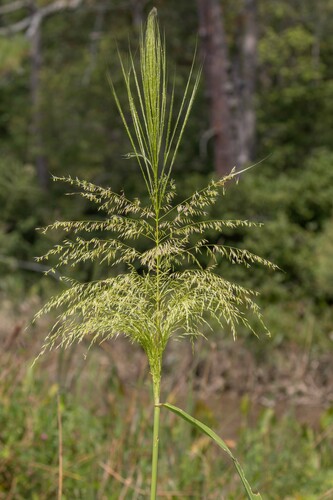
annual wild rice
Zizania aquatica
The towering annual wild rice is a keystone wetland species that feeds millions of migratory birds and provides a historic harvest for humans. Known for its shimmering seed heads and cultural importance, this aquatic giant is the backbone of healthy freshwater ecosystems.
Quick Identification
Size
Height 1–3 meters (3–10 feet); leaves 30–120 cm (1–4 feet) long and up to 4 cm (1.5 inches) wide.
Colors
Bright green foliage; flowering heads transition from light green to straw-colored; mature grains are dark brown to purplish-black.
Key Features
- Tall emergent grass reaching 2-10 feet
- Large terminal flower panicles with female flowers above male flowers
- Broad, flat leaves with a prominent midrib
- Grains are long, slender, and dark when mature
When You’ll See Them
Geographic range
Where Does the annual wild rice Live?
Native to the eastern half of North America, annual wild rice blankets the shallow waters and muddy banks of the Atlantic and Gulf coasts. This iconic aquatic grass is most prolific throughout the eastern United States, from the Saint Lawrence River down to Florida and west toward the Mississippi River basin. While it shares territory with its northern cousin, this species prefers the warmer, slower-moving waters of coastal marshes and inland river systems.
Basemap © OpenStreetMap contributors
Behavior
Annual wild rice is a fast-growing emergent aquatic grass that follows a strictly annual lifecycle, germinating from seeds buried in the underwater mud each spring. Its early growth is characterized by a 'floating leaf' stage, where the leaves lay flat on the water's surface, making it look almost like a pondweed. As it matures, it develops a thick, hollow stem that can tower over the water, eventually producing large, distinct flowering heads with the female flowers located above the male flowers on the same stalk.
In terms of ecological interaction, this plant forms dense 'stands' or colonies that act as a nursery for fish and a high-energy buffet for birds. For humans, annual wild rice has profound cultural and economic significance, particularly to Indigenous peoples who have harvested the grain for millennia. While it doesn't 'behave' in an animal sense, its response to water levels is critical; it thrives in stable, shallow environments and can be easily drowned by sudden floods or stressed by severe drought.
EverydayEarth exclusive
Camera Tips
To capture the majesty of annual wild rice, place your camera on a stabilized post or tripod within the marsh edge, roughly 3 to 4 feet above the water line. Angle the lens slightly upward to emphasize the plant's impressive height, which can reach up to ten feet. Because this species is highly reactive to wind, use a faster shutter speed (1/500 or higher) if your camera allows manual overrides, or select a 'sports' mode to avoid motion blur on the swaying seed heads. The best lighting occurs during the golden hour—just after sunrise or before sunset—when the light catches the translucent grains and creates a shimmering effect across the stand.
Since annual wild rice is a magnet for wildlife, positioning your camera near a healthy stand is an excellent strategy for capturing ducks, geese, and various songbirds. You don't need artificial bait; the ripening grain itself is the ultimate lure. For the best results, set your camera to trigger during the late summer months (August and September) when the seeds are heaviest. This is when you will see the most activity from species like Wood Ducks and Red-winged Blackbirds, which cling to the stalks to feed.
Consider setting up a long-term time-lapse to document the plant's fascinating transition from the floating-leaf stage in early June to the towering emergent stage in July. Ensure your camera housing is waterproof and secure against the humidity of a wetland environment. If you are targeting the animals that visit the rice, aim the camera at the 'shatter zone'—the area where ripe seeds fall into the water—as this is where waterfowl will congregate to forage.
Similar Species
Species that look similar or are commonly confused with annual wild rice.
Frequently Asked Questions
Record annual wild rice at your habitat
Connect a camera to start building your own species record — AI identifies every visitor automatically.