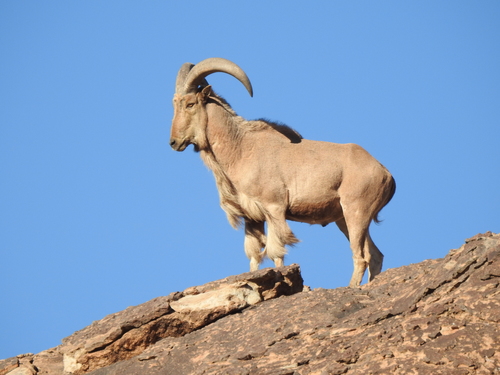
Aoudad
Ammotragus lervia
The ultimate rock-climber of the desert, the Aoudad is famous for its massive sweeping horns and the distinctive 'chaps' of hair that line its chest. Whether on the cliffs of the Sahara or the canyons of West Texas, this resilient sheep is a master of survival in the vertical world.
Quick Identification
Size
Length 130–190 cm (51–75 in); Shoulder height 75–110 cm (30–43 in); Weight 40–145 kg (90–320 lbs)
Colors
Uniform sandy-brown or tawny coat; lighter pale underbelly and inner legs; dark line along the spine
Key Features
- Heavy scimitar-shaped horns that curve backward and outward
- Long, flowing fringe of hair (chaps) from the throat to the front legs
- Strong, stocky build with thick legs adapted for climbing
- Broad forehead with large, yellowish-brown eyes
When You’ll See Them
Geographic range
Where Does the Aoudad Live?
Originally native to the rugged mountains of North Africa, the Aoudad’s ancestral home stretches across the rocky reaches of Morocco, Algeria, Tunisia, Libya, and Chad. They are the only wild sheep species native to Africa, though their populations there have become increasingly fragmented. In the mid-20th century, they were successfully introduced to the United States—specifically the arid canyons of Texas, New Mexico, and California—as well as parts of southern Spain and Mexico, where they now thrive in large numbers.
Basemap © OpenStreetMap contributors
Behavior
Aoudad are remarkably agile climbers, spending most of their lives on steep, rocky cliffs and canyon walls where they are safe from most land predators. They are masters of camouflage, often standing perfectly still against a rocky backdrop to avoid detection. While they are capable of living in large herds, they are frequently found in smaller groups of females and their offspring, while mature males tend to be more solitary or form small bachelor groups outside of the breeding season.
These sheep are crepuscular, meaning they are most active during the cooler hours of dawn and dusk. During the heat of the midday sun, they retreat to the shade of caves, overhanging rocks, or dense brush. In their introduced ranges, such as the American Southwest, they have a reputation for being exceptionally wary and elusive, using their keen eyesight and sense of smell to detect threats from great distances. When threatened, they can leap over two meters high from a standing start to navigate vertical terrain.
EverydayEarth exclusive
Camera Tips
To successfully capture Aoudad on camera, placement is everything. These animals are creatures of habit and will use the same rocky 'saddles' or narrow ridgeline trails to move between feeding and bedding areas. Position your camera at chest height—about 3 to 4 feet—and point it along a well-worn path on a steep slope. Because they are often found on inclines, ensure your camera is angled to capture the full profile of the animal, as their impressive horns and flowing chest fringe are their most striking features.
In the arid environments where Aoudad live, water is the ultimate attractant. If you have a water source or a 'guzzler' on your property, this is the most reliable spot for high-traffic photos. If water is unavailable and local laws permit, mineral or salt licks can be highly effective at stopping them in front of the lens. Use a fast trigger speed (0.5 seconds or less), as Aoudad are incredibly quick and can move through a camera's field of view in a heartbeat if they are startled.
Low-light performance is critical for this species. Since they are most active during the twilight hours, look for cameras with 'No-Glow' or 'Black Flash' infrared technology. Traditional red-glow LEDs can sometimes spook wary rams, causing them to avoid the area in the future. October and November are particularly good months for camera trapping, as the rutting season brings increased movement and the chance to film dramatic social behaviors like head-butting or scent-marking.
Similar Species
Species that look similar or are commonly confused with Aoudad.
Bighorn Sheep
Bighorns have thicker, more tightly curled horns and a prominent white rump patch, while Aoudad have sweeping horns and a long chest fringe.
Mountain Goat
Mountain goats have pure white shaggy coats and short, black, dagger-like horns compared to the sandy-brown coat and large curved horns of the Aoudad.
Frequently Asked Questions
Record Aoudad at your habitat
Connect a camera to start building your own species record — AI identifies every visitor automatically.