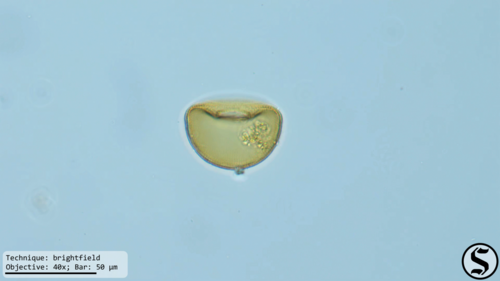
Arcella
Arcella hemisphaerica
Meet the microscopic architect of the pond world. Arcella hemisphaerica is a single-celled wonder that builds its own golden, dome-shaped fortress to patrol the hidden jungles of backyard moss.
Quick Identification
Size
100-150 micrometers (0.004-0.006 inches) in diameter
Colors
Translucent golden-yellow to deep amber-brown, occasionally colorless in younger specimens
Key Features
- Hemispherical, dome-shaped shell (test)
- Single central, circular opening called an aperture
- Blunt, finger-like pseudopodia
- Surface often has a fine, regular geometric pattern
When You’ll See Them
Geographic range
Where Does the Arcella Live?
This cosmopolitan species is found on every continent except Antarctica, thriving wherever there is sufficient moisture. It is particularly widespread across North America, Europe, and Asia, inhabiting everything from pristine mountain lakes to suburban drainage ditches. Because its microscopic cysts can be easily dispersed by the wind or on the feet of traveling birds, it successfully colonizes almost any permanent or semi-permanent freshwater source globally.
Basemap © OpenStreetMap contributors
Behavior
Arcella hemisphaerica is a remarkable microscopic architect that lives within a self-secreted, chitin-like shell known as a test. Unlike the naked amoebae often studied in biology classes, this species is a 'testate amoeba,' meaning it carries its home with it. It moves by extending lobopodia—blunt, temporary projections of its cytoplasm—through a hole in the bottom of its shell, effectively pulling itself along surfaces like a slow-moving tank.
These single-celled organisms are primarily solitary but can congregate in large numbers where food is abundant. They exhibit fascinating survival strategies; if their aquatic habitat begins to dry out, they can retreat entirely into their shells or form resilient cysts that can survive for long periods in a dormant state. They are essential players in the micro-food web, recycling nutrients and controlling bacterial populations in backyard ponds and soil.
EverydayEarth exclusive
Camera Tips
To capture Arcella hemisphaerica on camera, you must look beyond the capabilities of a traditional trail cam and move into the realm of micro-photography. Use a digital microscope or a high-magnification macro lens (10x or higher) attached to your smartphone. The best way to find them is to collect a 'pond squeeze'—gather a small amount of submerged moss or decaying leaves from a backyard pond and squeeze the water into a shallow petri dish or glass slide.
Lighting is critical for these translucent subjects. Use 'side-lighting' or oblique illumination to highlight the curvature of the hemispherical shell. If your camera setup allows for 'darkfield' settings, the golden-brown shell will glow brilliantly against a black background, making the intricate geometric patterns of the test visible. Place your camera on a steady tripod or a dedicated microscope stand to avoid blur at high magnifications.
Set your device to record time-lapse video over a period of 5 to 15 minutes. While they appear stationary to the naked eye, a time-lapse will reveal their slow, deliberate movement as they extend their pseudopodia to explore their environment. Look for them crawling along the bottom of your sample dish or clinging to the edges of microscopic debris; they are rarely found swimming freely in open water.
Similar Species
Species that look similar or are commonly confused with Arcella.
Frequently Asked Questions
Record Arcella at your habitat
Connect a camera to start building your own species record — AI identifies every visitor automatically.