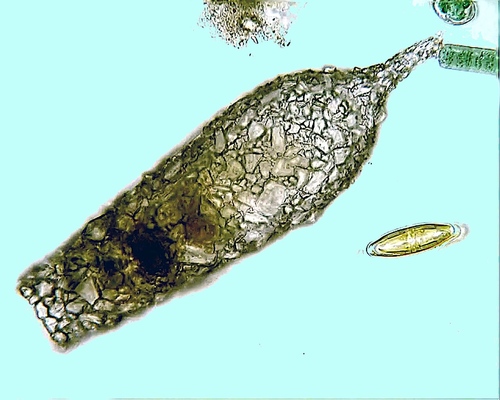
Difflugia
Cylindrifflugia acuminata
The microscopic architect of your backyard pond, Difflugia acuminata builds its own armor out of sand. This incredible 'testate' amoeba carries its house on its back, roaming the underwater forests of silt and moss.
Quick Identification
Size
150-350 micrometers (0.006-0.014 inches) in length
Colors
Translucent internal body with a shell ranging from sandy beige to dark brown depending on collected minerals
Key Features
- Cylindrical or acorn-shaped shell (test) made of sand grains
- Distinctly pointed apex at the top of the shell
- Clear, finger-like pseudopodia used for movement
- Single large opening (aperture) at the base
When You’ll See Them
Geographic range
Where Does the Difflugia Live?
The Difflugia acuminata is a cosmopolitan inhabitant of freshwater ecosystems found across nearly every continent. While they are most documented in the temperate regions of North America, Europe, and Asia, they are virtually ubiquitous in any healthy, moisture-rich environment ranging from backyard ponds to remote alpine lakes. Because they can enter a dormant state, they are easily dispersed by wind or water, allowing them to colonize almost any suitable body of water worldwide.
Basemap © OpenStreetMap contributors
Behavior
Movement is slow and deliberate. The amoeba extends lobe-like 'false feet' called pseudopodia through the opening at the bottom of its shell to anchor itself and pull its heavy house forward. It is a solitary creature, spending its entire life cycle within its shell, only emerging partially to feed or to build a new shell during the process of cell division.
EverydayEarth exclusive
Camera Tips
To capture Difflugia acuminata, you cannot use a standard trail camera; you will need a specialized AI-powered microscopy camera or a digital microscope attachment for your phone. Start by collecting a 'sludge' sample from the bottom of a backyard pond or squeezing the water out of a handful of damp moss. Place a few drops of this liquid onto a well-slide, which allows the amoeba space to move without being crushed by the cover slip.
For the best visual results, use 'Darkfield' or 'Phase Contrast' illumination if your camera supports it. This creates a high-contrast image where the amoeba's translucent body glows against a dark background, highlighting the rough, pebbled texture of its sand-grain shell. Because these creatures are benthic, focus your lens on the very bottom of the slide where they crawl along the glass surface.
Set your camera to a high-frame-rate video mode or a time-lapse setting with 1-second intervals. While they appear still to the naked eye, a time-lapse will reveal the fascinating way they extend their pseudopodia to drag their heavy shells. If you are using AI detection, calibrate it to recognize the distinct 'acorn' shape of the test, as the sand grains can sometimes confuse software looking for organic curves.
Similar Species
Species that look similar or are commonly confused with Difflugia.
Frequently Asked Questions
Record Difflugia at your habitat
Connect a camera to start building your own species record — AI identifies every visitor automatically.