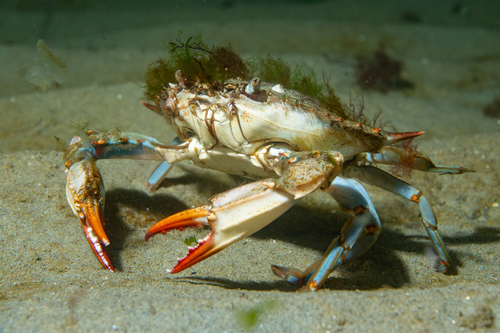
Atlantic Blue Crab
Callinectes sapidus
The sapphire-clawed sovereign of the salt marsh, the Atlantic Blue Crab is as famous for its aggressive personality as it is for its beautiful coloration. A master swimmer and an opportunistic hunter, this crab is a cornerstone of coastal ecosystems.
Quick Identification
Size
Carapace width 10-23 cm (4-9 inches); weight 150-450 g (0.3-1.0 lbs)
Colors
Olive or bluish-green carapace; males have bright blue claws; females have orange-red tips on their claws
Key Features
- Paddle-shaped rear legs for swimming
- Sharp lateral spines protruding from the sides of the shell
- Bright blue coloration on legs and claws
- T-shaped 'apron' on the belly of males, rounded on females
When You’ll See Them
Geographic range
Where Does the Atlantic Blue Crab Live?
Native to the western shores of the Atlantic Ocean, the Atlantic Blue Crab is found from the chilly waters of Nova Scotia down through the Gulf of Mexico to northern Argentina. It is most iconic in the Mid-Atlantic United States, particularly within the Chesapeake Bay. Beyond its native range, it has successfully established introduced populations in the Mediterranean Sea, the Baltic Sea, and parts of the Pacific coastline of Japan.
Basemap © OpenStreetMap contributors
Behavior
The Atlantic Blue Crab is a highly aggressive and mobile crustacean, distinguished from most other crabs by its incredible swimming ability. Using their paddle-like rear legs, they can dart through the water column with surprising speed to escape predators or chase down prey. They are famously feisty, often adopting a defensive 'display' posture with their claws wide open when they feel cornered.
These crabs are largely solitary and spend much of their time buried in the sand or mud with only their eyes and antennae exposed. This 'lie-in-wait' strategy allows them to ambush passing fish or hide from larger predators like herons and striped bass. They are also known for their complex migratory patterns, moving between the salty ocean and lower-salinity estuaries to mate and spawn.
EverydayEarth exclusive
Camera Tips
Capturing the Atlantic Blue Crab on camera requires a specialized approach, as they are primarily aquatic. The most effective method is using a waterproof action camera or a dedicated underwater trail camera. Mount the camera to a weighted base, such as a lead plate or a heavy brick, and submerge it near a dock, pier, or the edge of a salt marsh. Angle the lens slightly downward to focus on the seafloor, where crabs spend most of their time foraging.
Bait is essential for getting high-quality close-ups. Use a mesh bait bag filled with oily fish, like mackerel or menhaden, or the traditional crabber's choice: chicken necks. Secure the bait approximately 12 to 18 inches in front of the lens. This not only draws the crab into the frame but keeps it stationary as it picks at the food, allowing you to capture detailed textures of its carapace and the vibrant blue of its claws.
Timing your deployment with the tides is crucial for success. In tidal creeks and estuaries, crabs are most active when the water is moving, particularly during the incoming 'flood' tide. If you are using a camera in a shallow area, place it during low tide so you can ensure the framing is clear of seaweed or debris that might trigger the motion sensor unnecessarily. For the best color saturation, aim for midday sun which penetrates the water best; however, for behavioral shots of 'jimmies' (males) and 'sooks' (females), the evening hours are often most productive.
Similar Species
Species that look similar or are commonly confused with Atlantic Blue Crab.
Frequently Asked Questions
Record Atlantic Blue Crab at your habitat
Connect a camera to start building your own species record — AI identifies every visitor automatically.