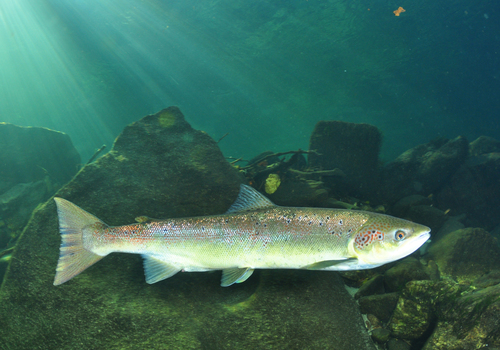
Atlantic Salmon
Salmo salar
Witness the 'King of Fish' on its epic journey from the deep ocean to mountain headwaters. A marvel of endurance and biological navigation, the Atlantic Salmon is a seasonal icon of our wildest rivers.
Quick Identification
Size
Typically 70–75 cm (28–30 in) and 3.6–5.4 kg (8–12 lbs), though some individuals can exceed 100 cm (39 in) and 20 kg (45 lbs).
Colors
Silvery-blue with scattered black X-shaped spots while at sea; breeding adults turn bronze, dark brown, or reddish with intensified spotting.
Key Features
- Small adipose fin located between the dorsal fin and tail
- Silver-blue scales with dark spots primarily above the lateral line
- Narrow 'wrist' at the base of the tail
- Pronounced hooked lower jaw (kype) in spawning males
When You’ll See Them
Geographic range
Where Does the Atlantic Salmon Live?
Atlantic Salmon are native to the cold waters of the North Atlantic Ocean and the interconnected river systems of the surrounding continents. Their range spans from the Northeastern United States and Maritime Canada over to Greenland and Iceland, and then across to the United Kingdom, Scandinavia, and the Baltic regions of Europe. While their numbers have faced historic declines, significant populations still thrive in the pristine rivers of Norway, Scotland, and Quebec, with specialized landlocked populations found in large inland lakes.
Basemap © OpenStreetMap contributors
Behavior
The Atlantic Salmon is often called the 'King of Fish' due to its incredible life cycle and leaping ability. They are anadromous, meaning they begin their lives in freshwater rivers, migrate to the saltwaters of the North Atlantic to grow and mature, and eventually return to their exact natal streams to spawn. This homing instinct is one of nature's most precise navigation feats, relying on a sophisticated sense of smell to find the river where they were born.
While in freshwater, salmon are highly territorial as juveniles but stop feeding almost entirely once they return as adults to spawn. Their behavior is defined by high-energy bursts, often seen leaping up waterfalls or over obstacles as high as 3.5 meters (11 feet). Unlike Pacific salmon species, some Atlantic Salmon can survive the spawning process and return to the sea to spawn again in future years, though the physical toll is immense.
EverydayEarth exclusive
Camera Tips
Capturing Atlantic Salmon requires an underwater housing or a specialized waterproof trail camera. For the best action shots, place your camera in shallow 'riffles' or near the base of small natural waterfalls where salmon are known to congregate before a leap. Position the camera at a 45-degree angle to the current to minimize water resistance and debris buildup on the lens. If you are using an AI-powered camera on a tripod, look for 'resting pools' where salmon pause to conserve energy; these provide the best opportunity for clear, still portraits.
Visibility is the biggest challenge in river photography. Use a camera with a high-quality glass lens and, if possible, a circular polarizing filter to cut through the surface glare if the camera is partially submerged. The best footage is often captured on overcast days when the light is diffused, as bright sunlight can create harsh reflections on the salmon's metallic scales. Set your camera to a high frame rate (60fps or higher) to capture the fluid motion of their powerful tails and the spray of water during a jump.
Seasonality is everything with this species. Research the 'run' times for your local river; usually, a significant rain event after a dry spell will trigger a mass movement of fish upstream. Ensure your camera is securely tethered to a permanent structure like a bridge piling or a heavy boulder, as river currents can increase rapidly during the autumn rains. Avoid using bright artificial lights at night, as this can spook migrating fish; instead, rely on high-sensitivity sensors or subtle infrared if the water clarity allows.
Similar Species
Species that look similar or are commonly confused with Atlantic Salmon.
Brown Trout
Brown trout have a thicker tail base and more numerous spots, often with pale halos, and their jaw extends further back.
Chinook Salmon
A Pacific species that is larger on average and has small black spots on both the upper and lower lobes of the tail.
Rainbow Trout
Rainbow trout (and Steelhead) possess a distinctive pinkish-red stripe along their sides and more heavily spotted fins.
Frequently Asked Questions
Record Atlantic Salmon at your habitat
Connect a camera to start building your own species record — AI identifies every visitor automatically.