Brown Trout
Salmo trutta
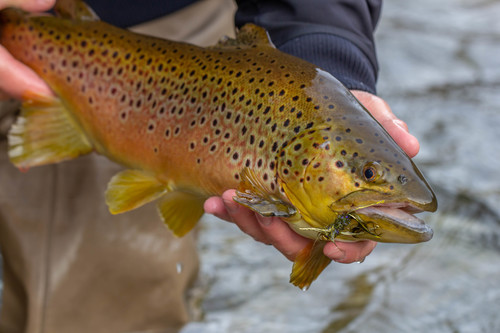
The ghost of the stream, the Brown Trout is a master of camouflage and one of the world's most prized freshwater fish. Distinguished by its golden hue and vibrant red spots, this resilient predator has conquered cool waters across nearly every continent.
Quick Identification
Size
Typically 12–20 inches (30–50 cm) in length and 1–5 lbs (0.5–2.3 kg), though trophy individuals can exceed 39 inches (100 cm) and 40 lbs (18 kg).
Colors
Golden-brown to olive-brown back and sides, fading to a yellowish or white belly; marked with dark brown or black spots often surrounded by pale halos, frequently interspersed with vibrant red or orange spots.
Key Features
- Golden-brown body with prominent dark spots
- Red or orange spots with light-colored halos along the flanks
- Square-shaped tail fin with very few or no spots
- Small adipose fin located between the dorsal fin and tail
- Strong, thick wrist (caudal peduncle) at the base of the tail
When You’ll See Them
Geographic range
Where Does the Brown Trout Live?
The Brown Trout is originally native to the continent of Europe, extending from the icy waters of Iceland and Scandinavia down to the Atlas Mountains of North Africa and eastward into Western Asia. Following its popularity as a premier game fish in the 19th century, it was widely introduced to every continent except Antarctica, establishing massive populations across the United States, Canada, New Zealand, and the southern tip of South America. Today, they are one of the most widely distributed freshwater fish on Earth, thriving in both their ancestral homes and their adopted mountain streams worldwide.
Basemap © OpenStreetMap contributors
Behavior
Brown Trout are known for being more elusive and wary than many other trout species, often seeking cover under overhanging banks, submerged logs, or deep rock crevices during the day. They are highly territorial, with dominant individuals claiming the best 'lies'—areas where the current brings food directly to them while they expend minimal energy. While younger fish are often found in riffles and shallower water, older, larger adults prefer deep pools and only emerge into the shallows under the cover of darkness or during high-water events.
As predators, they exhibit a high degree of intelligence and adaptability, often 'locking on' to specific insect hatches or seasonal food sources. In many regions, they are considered the ultimate challenge for anglers due to their keen eyesight and cautious nature. Unlike many other salmonids, Brown Trout are quite resilient to warmer water temperatures and can thrive in slightly more degraded habitats, though they still require cool, oxygen-rich environments to truly flourish.
EverydayEarth exclusive
Camera Tips
To capture Brown Trout with an AI-powered camera, placement is everything. If you have a backyard stream, look for 'holding water'—the transition zone where a fast-moving riffle flows into a deeper, slower pool. Position your camera (using a waterproof housing or specialized underwater unit) at the head of the pool, angled slightly upward toward the current. This is where trout wait for the water to deliver insects. For the best clarity, ensure the lens is positioned away from direct sunlight to minimize glare on the water's surface.
Large 'Brownies' are notoriously nocturnal and shy. If your camera has infrared or low-light capabilities, focus your monitoring on the hours just after sunset. This is when the biggest fish move out of deep cover and into the shallows to hunt. If you are using an above-water camera, a polarizing filter is essential; it cuts through the surface reflection and allows the AI to detect the fish's shape and movement beneath the water much more effectively.
During the autumn months, Brown Trout move into shallower gravel beds (redds) to spawn. This is the best time for high-action footage, as fish become more aggressive and less concerned with concealment. Look for areas of clean, pea-sized gravel in moving water. Set your camera to a high frame rate if possible, as their movements during territorial disputes or spawning can be lightning-fast. Avoid disturbing the gravel beds themselves to protect the developing eggs.
Similar Species
Species that look similar or are commonly confused with Brown Trout.
Rainbow Trout
Look for a pink lateral stripe and a heavily spotted tail fin, which Brown Trout lack.
Atlantic Salmon
Salmon have a more deeply forked tail and lack the red spots frequently found on Brown Trout.
Brook Trout
Actually a char; look for light-colored spots on a dark background and white leading edges on the lower fins.
Frequently Asked Questions
Record Brown Trout at your habitat
Connect a camera to start building your own species record — AI identifies every visitor automatically.