Brook Trout
Salvelinus fontinalis
The brook trout is a stunning 'living jewel' of North America's cold-water streams, recognizable by its vivid red spots and unique marble-patterned back. As a sensitive indicator species, its presence is a hallmark of the most pristine and untouched wilderness areas.
Quick Identification
Size
15–65 cm (6–25 inches) in length; weight ranges from 0.5 kg (1 lb) in small streams to 6.8 kg (15 lbs) for large 'coaster' forms.
Colors
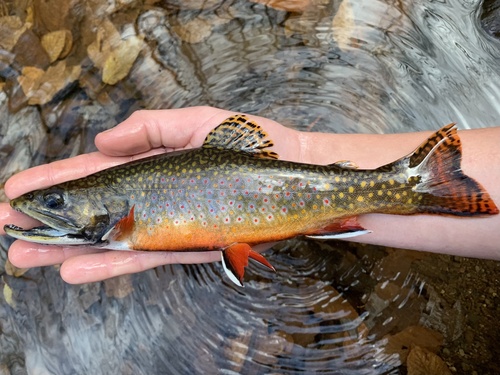
Olive-green to dark brown back with cream-colored wavy lines; sides feature red spots with blue halos and yellow spots; belly is white to orange-red; fins have white leading edges.
Key Features
- Wavy, worm-like markings (vermiculations) on the back and dorsal fin
- Small red spots surrounded by distinct blue halos along the sides
- Pectoral, pelvic, and anal fins have a striking white leading edge followed by a black stripe
- Square-shaped tail with light spotting
When You’ll See Them
Geographic range
Where Does the Brook Trout Live?
The brook trout is native to Eastern North America, with its original range stretching from the Appalachian Mountains in the United States northward through the Great Lakes and into the Arctic drainage of Canada. It is the state fish of several eastern states and is commonly found in the cool headwaters of the Northeast. Beyond its native shores, this resilient char has been introduced to high-altitude regions across the Western United States, Europe, South America, and parts of Asia, where it often thrives in alpine environments.
Basemap © OpenStreetMap contributors
Behavior
Brook trout are highly sensitive indicators of environmental health, requiring cold, clean, and well-oxygenated water to survive. They are primarily solitary and territorial, often claiming a specific 'lie' or hiding spot behind a rock or submerged log where the current delivers food directly to them. While they are known for their wariness and can be easily spooked by shadows or vibrations on the bank, they are aggressive predators when it comes to defending their territory or striking at prey.
During the autumn spawning season, brook trout undergo a dramatic transformation. Males develop a hooked lower jaw, known as a kype, and their bellies turn a brilliant, fiery orange to attract mates. They are known for their diverse life histories, with some populations remaining in small mountain brooks their entire lives, while others migrate to the Great Lakes or the Atlantic Ocean before returning to freshwater streams to spawn. Their interaction with humans is deep-rooted, as they are one of North America's most iconic game fish and a primary focus of cold-water conservation efforts.
EverydayEarth exclusive
Camera Tips
Capturing the vibrant colors of a brook trout requires an underwater camera setup, as their beauty is often lost when viewed from above the surface. Use a waterproof action camera or a trail camera with a high-quality underwater housing. For the best results, place the camera in a 'run'—a section of the stream where the water is moving but not turbulent—or at the tail-end of a deep pool. Secure the camera to a heavy rock or use a weighted tripod to prevent the current from shifting your frame.
Lighting is the most critical factor for underwater fish photography. Position your camera so it faces away from the direct sun to avoid 'backscatter,' where floating particles in the water reflect light and obscure the fish. The best footage is often captured during the 'golden hours' of early morning or late afternoon when the light is soft. If your camera has a 'time-lapse' mode, it can be more effective than motion-triggering, as the movement of water and debris can often cause false triggers on standard trail cams.
During the autumn spawning season (September to November), focus your camera on shallow gravel beds known as 'redds.' This is when brook trout are most active and colorful, and you can capture rare footage of males competing for territory. Avoid using artificial lures or bait, as these can disrupt the natural behavior of the fish and may be illegal in some conservation areas. Instead, look for natural 'funnels' in the stream—areas where the creek narrows or where fallen logs create a natural path for the fish to swim through.
Similar Species
Species that look similar or are commonly confused with Brook Trout.
Brown Trout
Brown trout have dark spots on a lighter body and lack the wavy vermiculations on their back found on brook trout.
Bull Trout
Bull trout lack the worm-like markings (vermiculations) on their dorsal fin and have a more elongated, less 'square' tail.
Rainbow Trout
Rainbow trout feature a prominent pinkish-red lateral stripe and many small black spots, but they lack the red spots with blue halos.
Frequently Asked Questions
Record Brook Trout at your habitat
Connect a camera to start building your own species record — AI identifies every visitor automatically.