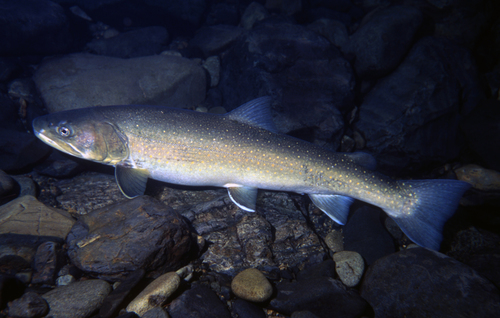
Bull Trout
Salvelinus confluentus
Often called the 'Ghost of the Rockies,' the Bull Trout is a sensitive apex predator that requires the coldest, cleanest waters in North America. These magnificent char are a true symbol of wilderness health and a prize for any backyard nature observer with a mountain stream.
Quick Identification
Size
12–40 inches (30–103 cm) in length; typically 2–10 lbs (0.9–4.5 kg), though record specimens reach over 30 lbs (14 kg).
Colors
Olive-green to blue-gray back with silvery sides; covered in pale yellow to orange-red spots. The belly is white or cream, turning bright orange-red in spawning males.
Key Features
- No black spots on the dorsal fin
- Pale yellow or orange spots without blue halos
- Distinct white leading edges on the pectoral, pelvic, and anal fins
- Large, flattened head with a prominent 'hooked' lower jaw in mature males
When You’ll See Them
Geographic range
Where Does the Bull Trout Live?
Native to the cold-water drainage basins of northwestern North America, the Bull Trout thrives in the Pacific Northwest and the northern Rocky Mountains. Its core range spans across British Columbia and Alberta in Canada, extending south into Washington, Oregon, Idaho, and western Montana. While they were historically found as far south as the McCloud River in California, modern populations are increasingly restricted to high-elevation refuges and protected wilderness areas.
Basemap © OpenStreetMap contributors
Behavior
Bull Trout are the apex predators of the cold-water streams they inhabit. Unlike many other trout species that feed primarily on insects, Bull Trout are highly piscivorous, meaning they actively hunt other fish once they reach adulthood. They are known for their 'sit-and-wait' predatory style, often lurking in the deep, shadows of pools or under log jams before striking with surprising speed.
These fish are extremely sensitive to water temperature and quality, requiring water consistently below 59°F (15°C) to thrive. They exhibit three distinct life histories: resident (staying in small headwater streams), fluvial (migrating between large rivers and small streams), and adfluvial (migrating between lakes and streams). They are solitary for most of the year but gather in high-elevation headwaters during the fall to spawn in gravel nests called redds.
Because they require the cleanest, coldest water, they are often used by biologists as an 'indicator species' for the overall health of a watershed. In areas where humans have altered stream flow or removed riverside vegetation, Bull Trout populations are usually the first to decline, making them a high-priority species for conservationists.
EverydayEarth exclusive
Camera Tips
Capturing Bull Trout on camera requires a specialized approach since they are entirely aquatic. If you have a backyard stream, the most effective method is using an underwater action camera (like a GoPro) or a trail camera secured inside a dedicated underwater housing. Mount the camera on a weighted base or a heavy rock in a 'tail-out'—the shallow area at the end of a deep pool where fish gather before moving upstream.
For those monitoring from above the water, bridge-mounting a camera looking straight down is highly effective. You must use a circular polarizer filter over the lens; this is the only way to cut through the surface reflection and glare to see the fish clearly. High-resolution settings are vital, as the olive-drab back of the Bull Trout provides excellent camouflage against a rocky stream bed.
During the fall spawning run (September to October), Bull Trout move into very shallow headwaters. This is the best time for photography. Position your camera near 'redds' (distinguishable patches of clean, light-colored gravel). Set your camera to take short video bursts rather than stills, as the movement of the fish—especially the aggressive 'tail-slap' of a female or the territorial displays of a male—is much easier for AI to identify than a static image of a camouflaged fish.
Because mountain water is often dark or shaded, choose a camera with a high-quality CMOS sensor that performs well in low light. If you are using an underwater rig, ensure the lens is positioned at a 45-degree angle to the current. This prevents bubbles and debris from collecting on the lens port, which can trigger false motions and blur your shots of these elusive 'ghosts of the Rockies.'
Similar Species
Species that look similar or are commonly confused with Bull Trout.
Dolly Varden
Dolly Varden are usually smaller, have a more rounded snout, and are more likely to be found in coastal, saltwater-influenced streams.
Brook Trout
Brook trout have dark, wavy 'worm' markings on their back and dorsal fin, which Bull Trout lack entirely.
Lake Trout
Lake Trout have a deeply forked tail, whereas the Bull Trout has a tail that is only slightly notched or nearly square.
Frequently Asked Questions
Record Bull Trout at your habitat
Connect a camera to start building your own species record — AI identifies every visitor automatically.