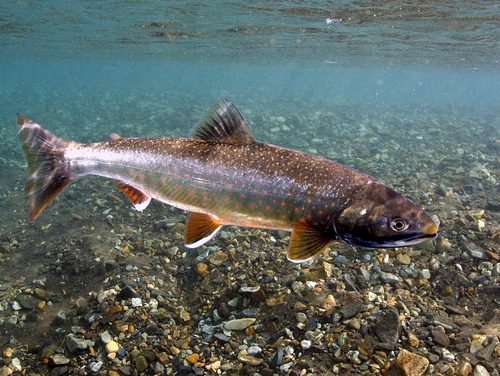
Dolly Varden
Salvelinus malma
A master of the cold Pacific currents, the Dolly Varden is a vibrant char known for its nomadic lifestyle and striking pink-spotted flanks.
Quick Identification
Size
30-60 cm (12-24 in) and 0.5-4 kg (1-9 lbs) for stream residents; anadromous individuals reach up to 90 cm (35 in) and 12 kg (27 lbs)
Colors
Olive green to muddy gray back with pale pink, yellow, or red spots; belly is silvery-white or cream; lower fins have distinct white leading edges
Key Features
- Pale spots on a dark background (no blue halos)
- Distinct white leading edges on pectoral, pelvic, and anal fins
- Upper jaw (maxilla) extends significantly past the eye
- Tail fin is slightly forked compared to bull trout
When You’ll See Them
Geographic range
Where Does the Dolly Varden Live?
The Dolly Varden is a true resident of the North Pacific rim, thriving in the cold, pristine waters that connect Asia and North America. Their native range extends from the northern islands of Japan and the Russian Far East across the Bering Sea to the Aleutian Islands. In North America, they are found throughout Alaska and down the Pacific coast through British Columbia into the mountainous regions of Washington state.
Basemap © OpenStreetMap contributors
Behavior
Dolly Varden are highly adaptable salmonids known for their complex and varied life histories. While some individuals spend their entire lives within a single mountain stream, others are semi-anadromous, migrating between freshwater rivers and the nutrient-rich coastal waters of the North Pacific. They are social yet competitive fish, often forming loose hierarchies in deep, slow-moving pools where they wait for food to drift into their strike zone.
During the autumn salmon spawning season, Dolly Varden are famous for their opportunistic behavior, often following schools of salmon upstream to feast on stray eggs. Despite their reputation as "egg-eaters," they are formidable predators that transition to a fish-based diet as they grow. While generally wary of movement above the water, they can become quite bold in clear water when focused on feeding or defending spawning territory.
EverydayEarth exclusive
Camera Tips
Capturing Dolly Varden on camera requires an underwater approach or a highly specialized bank-side setup. If your property includes a clear, shallow stream, mount your camera on a weighted base or a submerged stone, angling it slightly upward toward the water's surface to catch the shimmer of their scales. Polarized filters are essential if you are mounting a camera above the water to reduce surface glare and see into the water column.
The best time to deploy your camera is during the late summer and fall when these fish move into shallower tributaries to spawn or feed on salmon eggs. Look for "tail-outs"—the smooth, shallow areas at the downstream end of a deep pool—as fish often pause here before darting upstream. Use a high frame rate setting (60fps or higher) to capture their lightning-fast strikes at prey or territorial displays against other char.
While traditional land-based bait isn't effective, you can attract them to a specific frame by identifying natural bottlenecks in the stream. Placing your camera near a submerged log or a large boulder creates a natural resting spot where fish hide from the main current. Ensure your waterproof housing is meticulously cleaned to avoid lens flare, and check the focal distance, as water changes the effective magnification of your camera lens.
Similar Species
Species that look similar or are commonly confused with Dolly Varden.
Bull Trout
Bull trout have larger, flatter heads and their bodies are generally more elongated than the Dolly Varden.
Arctic Char
Arctic char have a more deeply forked tail and usually inhabit more northerly or higher-altitude lakes.
Brook Trout
Brook trout have distinct worm-like markings (vermiculations) on their backs, which Dolly Varden lack.
Frequently Asked Questions
Record Dolly Varden at your habitat
Connect a camera to start building your own species record — AI identifies every visitor automatically.