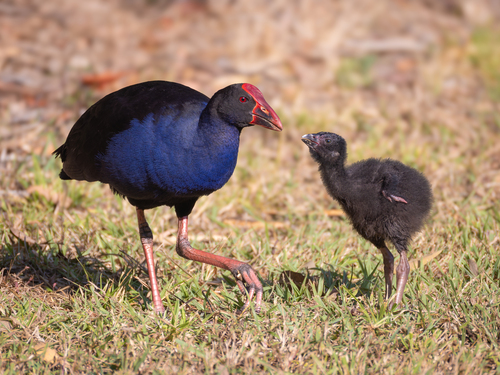
Australasian Swamphen
Porphyrio melanotus
With its brilliant indigo feathers and unmistakable red bill, the Australasian Swamphen is the bold, social architect of the Southern Hemisphere's wetlands. Whether known as the pūkeko or the swamphen, this intelligent bird is a master of the marsh.
Quick Identification
Size
Length: 38–50 cm (15–20 in); Wingspan: 90–100 cm (35–39 in); Weight: 850–1050 g (1.9–2.3 lbs)
Colors
Deep indigo-blue neck and breast; soot-black back and wings; bright red frontal shield and bill; reddish-pink legs; white undertail.
Key Features
- Large red bill and frontal shield
- Indigo-blue and black plumage
- Long reddish-pink legs with unwebbed toes
- Frequent tail-flicking showing white undertail
- Chicken-like build and gait
When You’ll See Them
Geographic range
Where Does the Australasian Swamphen Live?
The Australasian Swamphen is native to the vast landscapes of Oceania and the Malay Archipelago. Its core range covers almost all of Australia and New Zealand, stretching northward into Papua New Guinea, the Moluccas, and parts of eastern Indonesia. These adaptable birds are common residents across their range, often colonizing new territories quickly wherever human activity creates suitable damp habitats or agricultural pastures adjacent to water.
Basemap © OpenStreetMap contributors
Behavior
Australasian Swamphens, famously known as pūkeko in New Zealand, are highly social and intelligent birds characterized by their complex communal lifestyles. They are often seen in small groups, or 'tribes,' where they engage in cooperative breeding—multiple adults work together to defend a single nest and raise a communal brood of chicks. This social structure makes them fascinating to observe, as they constantly communicate through a series of loud, raucous squawks and subtle physical displays.
These birds are equally comfortable in water and on land. While they are capable fliers, they prefer to escape danger by running into thick vegetation or using their powerful legs to swim through reed beds. They have a unique foraging habit of using their long, dextrous toes to grasp food, such as reed stalks, and lift it to their beak to eat, much like a parrot. In suburban environments, they can become quite bold, frequently visiting parks and gardens that border waterways.
EverydayEarth exclusive
Camera Tips
To capture the best footage of an Australasian Swamphen, position your camera at a low angle, roughly 30–50 cm (12–20 inches) off the ground. These birds spend the majority of their time on foot, and a ground-level perspective captures their expressive facial shield and distinctive 'foot-feeding' behavior. Aim the lens toward the 'wetland fringe'—the transition zone between tall reeds and open grass where they often emerge to forage in the morning light.
Since swamphens are most active during the early morning and late afternoon, ensure your camera's trigger speed is set to its fastest setting to catch their jerky, rhythmic movements. They are highly social, so using 'Video' or 'Hybrid' mode is much more effective than single photos; you are likely to capture fascinating social interactions like communal grooming, territorial disputes, or the 'tail-flicking' display they use to signal alertness.
While we don't recommend artificial baiting, you can attract them to a specific spot by creating or maintaining a shallow, muddy edge or a low-profile birdbath if your backyard is near a creek. In suburban settings, they are curious and may investigate new objects, but avoid placing the camera too close to tall grass or reeds that might cause false triggers on windy days. Look for their distinctive, large three-toed tracks in soft mud to identify their preferred pathways.
Similar Species
Species that look similar or are commonly confused with Australasian Swamphen.
Frequently Asked Questions
Record Australasian Swamphen at your habitat
Connect a camera to start building your own species record — AI identifies every visitor automatically.