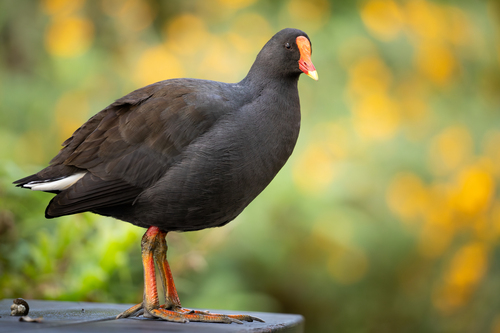
Dusky Moorhen
Gallinula tenebrosa
With its iconic red face and expressive tail-flicking, the Dusky Moorhen is the charismatic socialite of the local wetlands. Whether gliding through lily pads or grazing on a suburban lawn, this adaptable bird brings a splash of color to any backyard pond.
Quick Identification
Size
Length: 34-38 cm (13-15 in); Wingspan: 55-65 cm (22-26 in); Weight: 300-600 g (10.5-21 oz)
Colors
Uniform slate-grey to charcoal body with olive-brown wings; prominent red frontal shield and bill with a yellow tip; white outer undertail feathers; yellow-green legs.
Key Features
- Bright red frontal shield and bill with yellow tip
- White feathers on the sides of the undertail
- Slate-grey underparts and brownish-tinged back
- Constantly flicks tail while walking or swimming
When You’ll See Them
Geographic range
Where Does the Dusky Moorhen Live?
Native to the Australasian and Indo-Malayan regions, the Dusky Moorhen is a common sight across the eastern and southwestern coasts of Australia. Its range extends north through the island of New Guinea and across the Indonesian archipelago into parts of Borneo. While they are primarily found in lowland wetlands, they are incredibly successful at colonizing urban parklands and artificial lagoons throughout their range.
Basemap © OpenStreetMap contributors
Behavior
These birds are fascinating for their cooperative breeding habits. Often, several adults will assist a primary breeding pair in defending a territory and raising a single brood of chicks. They can be quite territorial and vocal during the breeding season, emitting a range of sharp squawks and 'kurruk' calls to warn off intruders. While they appear calm, they are quick to defend their patch of reeds from rival moorhens or even larger birds like swamphens.
EverydayEarth exclusive
Camera Tips
In terms of settings, these birds are surprisingly fast when they strike at insects or squabble with neighbors. A fast trigger speed and a short video burst (10-15 seconds) are ideal. If your camera allows for exposure compensation, underexposing by -0.5 or -1.0 can help prevent the bright red frontal shield on their head from 'blowing out' or losing detail in the sun. If you are using a trigger-based camera, set the PIR sensitivity to 'High' to ensure it picks up their movement against the often-busy background of swaying reeds.
If you have a backyard with a water feature, you don't necessarily need food to attract them—a clean, shallow sloping edge into the water is often enough. However, they are attracted to areas with floating vegetation or low logs where they can climb out of the water to dry their wings. Since they are resident birds, once you find a pair or a family group, they are likely to remain in the area year-round, allowing you to capture the progression from their fluffy black 'drumstick' chicks to mature adults.
Similar Species
Species that look similar or are commonly confused with Dusky Moorhen.
Frequently Asked Questions
Record Dusky Moorhen at your habitat
Connect a camera to start building your own species record — AI identifies every visitor automatically.