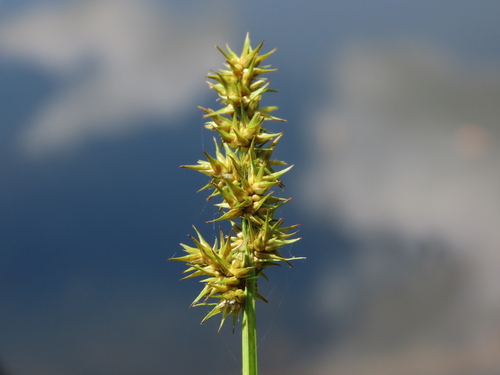
awl-fruited sedge
Carex stipata
A champion of the wetlands, the awl-fruited sedge is a hardy, clump-forming plant known for its striking triangular stems and prickly, fox-tail flower heads. It serves as a vital anchor for soggy soils and a sanctuary for backyard amphibians.
Quick Identification
Size
Typically reaches 30 to 100 cm (12 to 39 inches) in height with a spread of 45 to 60 cm (18 to 24 inches).
Colors
Bright emerald green foliage; flower spikes turn from light green to a yellowish-tan or deep brown as they mature.
Key Features
- Distinctly triangular, spongy stems that feel thick near the base
- Dense, prickly, yellowish-brown flower clusters resembling a fox's tail
- Leaf sheaths featuring characteristic horizontal wrinkles (rugose)
- Clump-forming growth habit with broad, flat leaf blades
When You’ll See Them
Geographic range
Where Does the awl-fruited sedge Live?
The awl-fruited sedge is native to a vast portion of the Northern Hemisphere, spanning across North America and Eastern Asia. In the Western Hemisphere, its core range covers nearly all of southern Canada and the United States, from the Atlantic to the Pacific coast, though it is less common in the arid Southwest. Across the ocean, it thrives in the temperate wetlands of China, Japan, Korea, and the Russian Far East, making it a truly circumboreal presence in the plant world.
Basemap © OpenStreetMap contributors
Behavior
The awl-fruited sedge is a robust, perennial plant that plays a vital role in wetland ecosystems. Unlike many grasses, it grows in dense, architectural clumps (tussocks) that provide essential structure in soggy soil. It is a 'wetland obligate,' meaning it is almost always found in areas with saturated soil or standing water. It spreads primarily through seeds and short rhizomes, helping to stabilize banks and prevent erosion in sensitive riparian zones.
Ecologically, this sedge acts as a nursery for various backyard wildlife. Its dense foliage offers high-quality cover for frogs, salamanders, and small wetland birds. While it doesn't move like an animal, it responds dynamically to the seasons, blooming in late spring and providing a buffet of seeds for waterfowl and songbirds by mid-summer. For humans, it is a low-maintenance 'workhorse' plant often used in rain gardens to manage runoff.
EverydayEarth exclusive
Camera Tips
Capturing the awl-fruited sedge on camera requires a different approach than moving wildlife. To get the best shots of its unique 'awl-shaped' fruits, set your camera to a macro or close-up mode. Because this plant lives in wetlands, use a tripod with a low-angle adjustment to get level with the flower spikes. The best time to photograph them is during the 'golden hour'—shortly after sunrise or before sunset—when the low light catches the prickly texture of the seed heads, making them glow against a dark wetland background.
If you are using an AI-powered trail camera, place it at a height of about 12 to 18 inches, angled slightly upward towards the sedge clump. This position is perfect for catching not just the plant, but the many visitors it attracts. Position your camera near a sedge cluster at the edge of a pond or rain garden to document the biodiversity it supports, such as dragonflies perching on the stems or frogs hiding at the base.
For a unique perspective, try a time-lapse setting over several weeks in late spring. You can watch the inflorescences transform from tight green buds into the sprawling, prickly tan clusters that give the plant its name. Ensure your camera is well-waterproofed, as the humid, damp environment where this sedge thrives can lead to lens fogging; using a small desiccant pack inside the camera housing can help maintain clarity.
Similar Species
Species that look similar or are commonly confused with awl-fruited sedge.
Frequently Asked Questions
Record awl-fruited sedge at your habitat
Connect a camera to start building your own species record — AI identifies every visitor automatically.