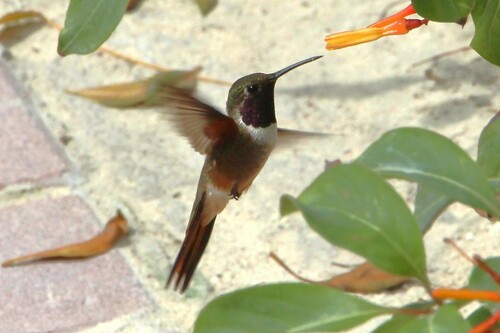
Bahama Woodstar
Nesophlox evelynae
The Bahama Woodstar is a shimmering endemic treasure of the Lucayan islands. Known for its metallic 'hum' and the male's brilliant purple throat, this tiny acrobat is a favorite for backyard birdwatchers.
Quick Identification
Size
Length: 8-9.5 cm (3.1-3.7 in); Wingspan: 10-11 cm (3.9-4.3 in); Weight: 2.4-3.6 g (0.08-0.13 oz)
Colors
Iridescent green upperparts; males have a brilliant violet-purple gorget (throat) and white breast; females have buffy/cinnamon underparts and lack the purple throat.
Key Features
- Striking iridescent purple throat patch on males
- Long, slender, slightly decurved bill
- White spot directly behind the eye
- Forked tail in males vs rounded tail with rufous tips in females
When You’ll See Them
Geographic range
Where Does the Bahama Woodstar Live?
The Bahama Woodstar is a native jewel of the Caribbean, found exclusively within the Lucayan Archipelago. Its core range spans nearly all the major islands of the Bahamas, as well as the Turks and Caicos Islands. While they are sedentary residents that do not migrate, they are occasionally documented as rare vagrants in the southern tip of Florida.
Basemap © OpenStreetMap contributors
Behavior
The Bahama Woodstar is a remarkably energetic and agile flyer, spending much of its day darting between nectar sources with high-speed precision. Locally known as the 'hummer,' this bird produces a low-frequency buzzing sound with its wings that is distinct from other hummingbird species. While they are generally solitary, they are highly territorial over prime feeding spots and will engage in high-speed chases to drive off intruders.
Human presence doesn't easily rattle these birds; they are frequent visitors to residential gardens and can become quite bold around sugar-water feeders. During the breeding season, the males perform dramatic U-shaped aerial displays. They fly to great heights and then dive downward at incredible speeds, using their tail feathers to create a sharp, mechanical 'metallic' sound at the bottom of the arc to impress nearby females.
EverydayEarth exclusive
Camera Tips
To successfully capture the Bahama Woodstar on your backyard camera, focus your efforts on 'hotspots' like nectar feeders or specific flowering plants such as Firebush (Hamelia patens) or Cape Honeysuckle. Place your camera on a tripod or mount it approximately 3 to 4 feet away from the target flower cluster. Because these birds are so small, a close-focusing distance is essential to fill the frame and help the AI accurately identify the species.
Lighting is the most critical factor for capturing the male's stunning iridescent purple throat. Position your camera so the sun is at its back, shining directly onto the area where the bird will hover. If the bird is backlit, the throat will appear black; with the sun behind the camera, the gorget will 'glow' with a brilliant violet light. High-speed shutter settings or 'Action' modes are recommended to freeze the wing motion, which can exceed 50 beats per second.
For the best results, set your camera to capture short video clips or high-frequency bursts rather than single photos. These birds often hover for only a few seconds before zipping away. If your camera has a 'Pre-roll' feature, enable it so you don't miss the arrival. Additionally, consider the background; a soft, out-of-focus green or blue background will make the bird's vibrant colors pop much more than a cluttered or high-contrast setting.
Finally, consistency is key. Keep your feeders clean and filled with a standard 4:1 water-to-sugar ratio (no red dye). Once a Woodstar identifies your yard as a reliable food source, it will return multiple times a day on a predictable circuit, giving you numerous opportunities to refine your camera angles and capture the perfect shot.
Similar Species
Species that look similar or are commonly confused with Bahama Woodstar.
Frequently Asked Questions
Record Bahama Woodstar at your habitat
Connect a camera to start building your own species record — AI identifies every visitor automatically.