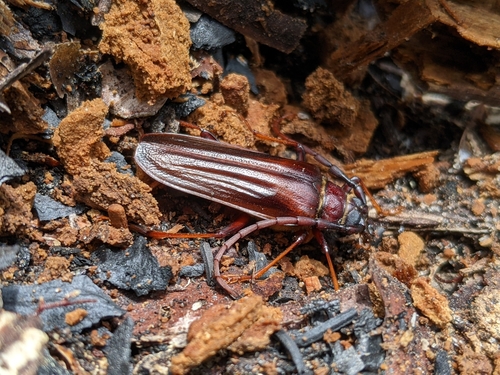
Bahiagrass Borer
Derobrachus brevicollis
A titan of the Southeastern backyard, the Bahiagrass Borer is one of North America's largest and most impressive beetles. These nocturnal giants emerge on humid summer nights, appearing like relics from a prehistoric age.
Quick Identification
Size
35–60 mm (1.4–2.4 inches) in length; heavy, robust body
Colors
Dark chocolate brown to reddish-brown; leathery wing covers; males have significantly longer antennae than females
Key Features
- Three sharp spines on each side of the thorax
- Very long, sweeping segmented antennae
- Large, prominent mandibles (pincers)
- Broad, flattened mahogany-colored body
When You’ll See Them
Geographic range
Where Does the Bahiagrass Borer Live?
Native to the North American continent, the Bahiagrass Borer is a quintessential species of the Southeastern United States. Its core range is centered in the Gulf Coast and South Atlantic states, stretching from the Florida peninsula northward into North Carolina and westward through Alabama and Mississippi into Louisiana. It is most frequently encountered in regions with sandy soils where its preferred host plants are abundant.
Basemap © OpenStreetMap contributors
Behavior
The Bahiagrass Borer is a member of the longhorn beetle family, celebrated for its impressive size and somewhat prehistoric appearance. While the adults are the most visible stage of their life cycle, they spend the vast majority of their lives—up to three years—underground as larvae. These large, creamy-white grubs tunnel through the soil, using their powerful mandibles to feed on the roots of various grasses and trees.
As adults, they emerge during the hottest, most humid weeks of summer with a single goal: reproduction. They are primarily nocturnal and are famous for their clumsy flight patterns; they are frequently seen crashing into window screens or circling porch lights. While their large mandibles look intimidating and can deliver a sharp pinch if the insect is mishandled, they are not aggressive and do not possess a sting.
EverydayEarth exclusive
Camera Tips
Capturing the Bahiagrass Borer on camera requires a focus on nighttime activity during the height of summer. Because these beetles are highly phototactic—meaning they are naturally attracted to light—the most effective way to get them in front of your lens is to position your camera near an artificial light source. A porch light, a specialized UV moth light, or even a bright LED lantern positioned against a white sheet will act as a beacon for these large insects.
For the best framing, mount your camera at a low angle, roughly 12 to 24 inches off the ground, or point it directly at a vertical surface like a tree trunk or a wooden fence where the beetles might land to rest. Since they are relatively slow-moving when crawling, you can use a macro lens or a close-up focus setting if your camera supports it. Ensure your infrared or "night vision" settings are optimized, though capturing them in color using a nearby external light source provides much better detail of their rich, mahogany-colored shells.
Timing is critical for this species; you will have the most success on warm, humid evenings, particularly those following a heavy summer rain shower in July or August. If you are using a motion-triggered camera, set the sensitivity to its highest level, as insects can sometimes fail to trigger sensors designed for larger mammals. Setting your camera to record short video clips (10-15 seconds) is often more rewarding than still photos, as it captures their distinctive, scrambling walk and the constant movement of their long antennae.
Similar Species
Species that look similar or are commonly confused with Bahiagrass Borer.
Frequently Asked Questions
Record Bahiagrass Borer at your habitat
Connect a camera to start building your own species record — AI identifies every visitor automatically.