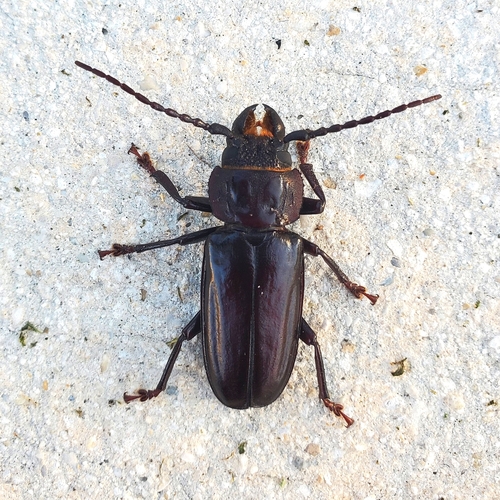
Hardwood Stump Borer
Mallodon dasystomus
A titan of the backyard woodpile, the Hardwood Stump Borer is a glossy, heavy-bodied beetle famous for its massive mandibles and nocturnal buzzing flights. As a master decomposer, it transforms old wood into new life across the American South.
Quick Identification
Size
35-50 mm (1.4-2.0 inches) in length
Colors
Glossy dark reddish-brown to nearly black; males feature significantly larger, prominent mandibles
Key Features
- Large, forward-facing mandibles (especially in males)
- Broad, flattened dark brown body
- Serrated or 'toothed' edges on the pronotum (neck area)
- Thick, segmented antennae roughly half the length of the body
When You’ll See Them
Geographic range
Where Does the Hardwood Stump Borer Live?
Native to the Americas, the Hardwood Stump Borer is most commonly found across the southern and southeastern United States, ranging from Virginia down through Florida and as far west as Texas and Arizona. Its territory extends southward through Mexico and Central America, reaching into northern South America. This species thrives in warm, humid climates where large-diameter hardwood trees are abundant, making it a frequent visitor to both rural forests and well-landscaped suburban neighborhoods in the Sunbelt.
Basemap © OpenStreetMap contributors
Behavior
During the day, these beetles remain tucked away in the deep crevices of bark or under fallen logs to avoid predators. The majority of their life cycle is actually spent as larvae (grubs) inside the wood of hardwood trees. They play a vital ecological role as primary decomposers, breaking down dead or dying timber and recycling nutrients back into the soil, though they can be a nuisance in managed orchards or timber stands.
EverydayEarth exclusive
Camera Tips
To capture the Hardwood Stump Borer on your backyard camera, focus your efforts on decaying hardwood logs, particularly oak or pecan. Mount your camera low to the ground—about 12 to 18 inches high—and angle it to look along the length of a fallen log. This is where the beetles are most likely to be seen scuttling in search of mates or egg-laying sites. Because they are glossy and dark, use a camera with 'no-glow' or adjustable infrared settings to prevent the flash from bouncing off their shells and overexposing the image.
These beetles are highly attracted to ultraviolet (UV) light. If you are struggling to get them on camera, placing a small solar-powered UV light or even a standard porch light near the camera's field of view will act as a powerful lure. They will often land on nearby vertical surfaces, like fence posts or tree trunks, to rest after being attracted to the light, providing the perfect opportunity for a high-detail macro shot.
Timing is everything with this species. They are most active on humid, sultry summer nights, especially after a afternoon thunderstorm. Set your camera to 'Burst Mode' or 'Photo + Video' because while they look bulky, they can move surprisingly fast when they decide to crawl. Ensure your PIR (passive infrared) sensor sensitivity is set to high, as insects do not always trigger sensors designed for larger mammals unless they pass very close to the lens.
Similar Species
Species that look similar or are commonly confused with Hardwood Stump Borer.
Frequently Asked Questions
Record Hardwood Stump Borer at your habitat
Connect a camera to start building your own species record — AI identifies every visitor automatically.