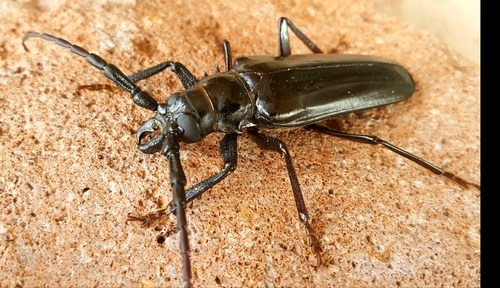
Palo Verde Root Borer
Derobrachus hovorei
One of North America's largest beetles, the Palo Verde Root Borer is a spectacular desert giant that emerges with the summer monsoons. Though they look intimidating, these 'monsoon beetles' are harmless seasonal visitors to desert backyards.
Quick Identification
Size
2.5 to 3.5 inches (6 to 9 cm) in length
Colors
Uniformly dark brown to nearly black with a matte to slightly glossy exoskeleton
Key Features
- Large, robust body reaching up to 3.5 inches
- Three distinct sharp spines on each side of the thorax
- Very long, segmented antennae typical of longhorn beetles
- Large, prominent mandibles used for defense
When You’ll See Them
Geographic range
Where Does the Palo Verde Root Borer Live?
This impressive beetle is a signature inhabitant of the North American desert southwest. Its native range extends across the Sonoran and Mojave Deserts, primarily within the states of Arizona, New Mexico, and Southern California, as well as Northern Mexico. Because they are closely tied to their namesake trees, they are most frequently encountered in suburban developments in cities like Phoenix and Tucson where Palo Verde trees are common in landscaping.
Basemap © OpenStreetMap contributors
Behavior
EverydayEarth exclusive
Camera Tips
To catch a Palo Verde Root Borer on camera, timing is everything. These beetles emerge during the 'Monsoon Season' in the Southwest, typically from late June through August. Because they are strongly attracted to light, placing your AI camera near a porch light or a low-voltage garden light is the most effective way to trigger a capture. They are clumsy fliers and will often crash-land near light sources before crawling around on the ground.
For a more natural 'action shot,' mount your camera just 6 to 12 inches off the ground near the base of a Palo Verde or Mesquite tree. This is where the beetles emerge from the soil or where females return to lay eggs. Use a wide-angle setting if available, as these insects are quite large and can easily fill the frame if they crawl too close to the lens.
Since these beetles are most active during the evening and night, ensure your camera has high-quality infrared (IR) night vision or a 'no-glow' flash that won't overexpose their dark, reflective shells. Because they move relatively slowly when crawling but can be erratic when taking off, a camera with a fast recovery time will help you catch the entire sequence from emergence to flight.
Avoid using food baits, as adult Palo Verde Root Borers lack a functional digestive system and do not eat. Instead, focus on 'pathway' placement—set your camera to face a brick wall or a flat patio area where their dark silhouettes will stand out clearly against the background. If your camera has a 'Time Lapse' mode, it can be a great way to monitor a specific tree trunk throughout a humid July evening.
Similar Species
Species that look similar or are commonly confused with Palo Verde Root Borer.
Frequently Asked Questions
Record Palo Verde Root Borer at your habitat
Connect a camera to start building your own species record — AI identifies every visitor automatically.