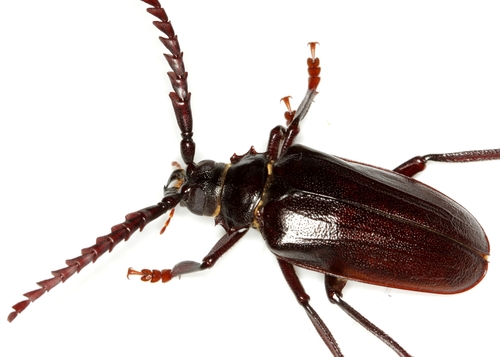
California Root Borer
Prionus californicus
A titan of the western landscape, the California Root Borer is one of North America's largest and most impressive longhorn beetles.
Quick Identification
Size
2.5–6 cm (1.0–2.4 inches) in length
Colors
Uniformly dark reddish-brown to nearly black; smooth, glossy finish
Key Features
- Large, robust reddish-brown body
- Strongly serrated (saw-toothed) antennae, especially in males
- Three sharp lateral spines on each side of the thorax
- Strong, visible mandibles
When You’ll See Them
Geographic range
Where Does the California Root Borer Live?
The California Root Borer is native to the western regions of North America. Its primary range extends from southern British Columbia in Canada, through the western United States—particularly the Pacific Coast and Rocky Mountain states—and reaches as far south as northern Mexico. It is a common sight in both wild woodland ecosystems and agricultural areas where its host plants are abundant.
Basemap © OpenStreetMap contributors
Behavior
The California Root Borer is a nocturnal powerhouse of the insect world, emerging from the soil during the warm summer months. Adult beetles are primarily focused on reproduction; because they have a very short lifespan of only a few weeks, they often do not feed at all, living off energy stored during their years as larvae. Males are strong, clumsy flyers that use their sensitive, saw-like antennae to detect pheromones released by females from the ground or tree trunks.
When threatened, these beetles may produce a faint hissing sound by rubbing their legs against their wing covers, a defensive behavior known as stridulation. Despite their intimidating size and powerful-looking jaws, they are not aggressive toward humans, though they can deliver a sharp pinch if handled. They are most frequently encountered by homeowners when they are drawn to porch lights or found crawling across driveways on humid July nights.
EverydayEarth exclusive
Camera Tips
To capture high-quality footage of a California Root Borer, timing is everything. These beetles are highly seasonal, appearing almost exclusively during the hottest weeks of summer. Because they are strongly attracted to light (phototaxis), the most effective setup is to place your camera near an existing outdoor light source, such as a porch light or a low-voltage garden lamp. If your camera is portable, try setting it up facing a light-colored vertical surface like a fence or a sheet with a small LED light shining on it; the beetles will often land and crawl here, providing a stable subject for the lens.
Position your camera low to the ground—ideally between 6 and 12 inches high. Many users find success placing cameras on the edges of patios or near the base of large, older trees where the beetles may be emerging from the soil or where females may be waiting for mates. Since they are most active in total darkness, ensure your camera's infrared (night vision) settings are optimized. A camera with a fast trigger speed is helpful for catching males in flight, though they are often slow enough when crawling to be captured by standard motion sensors.
If you are targeting the beetles in a garden or orchard, look for 'exit holes' in the soil near the base of trees, which are roughly the size of a thumb. Placing a camera near these holes during July can capture the dramatic moment an adult emerges for the first time. For the best detail, use a macro lens setting if available, as the intricate serrations on the male's antennae are a spectacular sight when viewed up close.
Similar Species
Species that look similar or are commonly confused with California Root Borer.
Frequently Asked Questions
Record California Root Borer at your habitat
Connect a camera to start building your own species record — AI identifies every visitor automatically.