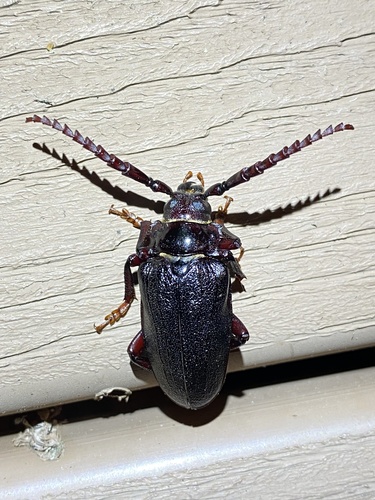
Broad-necked Root Borer
Prionus laticollis
A heavy-armored titan of the summer night, the Broad-necked Root Borer is one of the most impressive beetles you can discover in your own backyard. Known for its serrated antennae and powerful build, this nocturnal wanderer is a fascinating glimpse into the hidden world of forest giants.
Quick Identification
Size
Adults typically measure 22–45 mm (0.9–1.8 inches) in length, with females being significantly larger and bulkier than males.
Colors
Deep mahogany brown to shiny black; antennae are dark and segmented, with males possessing more prominent, serrated segments.
Key Features
- Broad, flared prothorax with three distinct sharp teeth on each side
- Robust, heavy-set body with a glossy, armored appearance
- Large, deeply notched (serrated) antennae, especially in males
- Strong mandibles capable of pinching if handled
When You’ll See Them
Geographic range
Where Does the Broad-necked Root Borer Live?
Native to the North American continent, the Broad-necked Root Borer is a prominent resident of the eastern half of the United States and southeastern Canada. Its core territory extends from the southern reaches of Quebec and Ontario, stretching down the Atlantic coast to Florida, and reaching as far west as the wooded regions of Oklahoma and Arkansas. They are particularly common in the Appalachian corridor and the temperate broadleaf forests of the Midwest.
Basemap © OpenStreetMap contributors
Behavior
The Broad-necked Root Borer is a nocturnal giant that spends the vast majority of its life hidden from human eyes. While the larvae live underground for several years, the adults emerge during the mid-summer months with a single-minded focus: reproduction. They are most active on humid summer nights, where they can often be found crawling along the forest floor or clumsily flying toward artificial light sources.
Despite their somewhat intimidating appearance and large size, these beetles are not aggressive toward humans. Males are more active fliers, searching for the pheromones released by the heavier, often flightless females. Because the adults have a very short lifespan—lasting only a few weeks—they rarely feed, living instead off the energy reserves they accumulated as larvae.
EverydayEarth exclusive
Camera Tips
To capture the Broad-necked Root Borer on camera, timing and lighting are everything. Since these beetles are highly attracted to light (phototactic), the best method is to set up your AI camera near an external light source, such as a porch light or a specialized UV 'blacklight' trap. Positioning the camera to face a white sheet illuminated by a light will often result in the beetle landing directly in the frame, providing clear, high-contrast shots of their armored bodies.
Because females are heavy and frequently crawl rather than fly, try placing one of your cameras at ground level near the base of old oak trees or rotting stumps. Set the camera to a macro or close-focus mode if available, as these insects are relatively small compared to mammals but large for insects. A low angle will capture the impressive 'toothed' detail of their thorax and their formidable mandibles.
Since they are most active during the warmest, most humid nights of mid-summer, check your camera frequently during July. Set your trigger interval to its shortest setting, as these beetles can be quite clumsy and may tumble out of the frame quickly. If you are using a trigger-based AI camera, ensure the sensitivity is high enough to detect the movement of a large insect at close range.
Similar Species
Species that look similar or are commonly confused with Broad-necked Root Borer.
Tile-horned Prionus
The Tile-horned Prionus has even more antennae segments (12-13 or more) which overlap like roof tiles, and its prothorax is less wide.
Palo Verde Root Borer
Found primarily in the Southwest, it is much larger and thinner, with longer legs and a different host tree preference (Palo Verde trees).
Brown Prionid
Usually lighter in color and more slender, with less pronounced spines on the sides of the thorax.
Frequently Asked Questions
Record Broad-necked Root Borer at your habitat
Connect a camera to start building your own species record — AI identifies every visitor automatically.