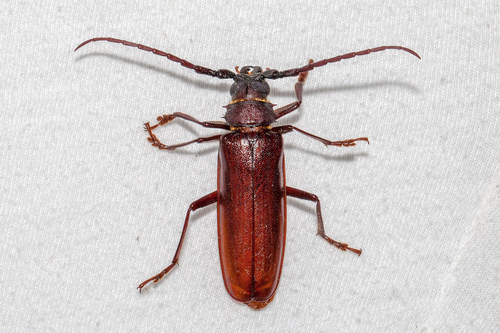
Brown Prionid
Orthosoma brunneum
A mahogany-colored titan of the summer night, the Brown Prionid is one of the most impressive longhorn beetles found in North American backyards. Known for its distinctive 'toothed' thorax and massive antennae, it plays a vital role in recycling old wood back into the earth.
Quick Identification
Size
22–45 mm (0.8–1.8 inches) in length
Colors
Uniformly light brown to deep mahogany reddish-brown with a glossy texture
Key Features
- Elongated, parallel-sided mahogany body
- Three sharp teeth/spines on each side of the thorax
- Long, segmented antennae reaching at least half the body length
When You’ll See Them
Geographic range
Where Does the Brown Prionid Live?
Native to North America, the Brown Prionid is a widespread resident of the eastern United States and southeastern Canada. Its territory spans from the Atlantic coast westward to the Great Plains, reaching as far south as the Gulf states. It is particularly abundant in regions with mature hardwood forests where fallen timber provides ample breeding grounds.
Basemap © OpenStreetMap contributors
Behavior
The Brown Prionid is a nocturnal longhorn beetle that emerges in mid-to-late summer. While they are clumsy flyers, they are remarkably persistent, often heard buzzing loudly as they collide with window screens or outdoor lights. During the day, they remain hidden in dark, moist crevices, under loose bark, or within leaf litter to avoid predation by birds and small mammals.
As adults, their primary focus is reproduction. They use their sensitive antennae to detect pheromones and find mates. While they appear formidable due to their size and powerful mandibles, they are not aggressive toward humans. However, they can deliver a sharp pinch if handled, as their jaws are designed for chewing through tough wood fibers during their larval stage.
EverydayEarth exclusive
Camera Tips
To capture high-quality footage of a Brown Prionid, your best bet is to leverage their strong attraction to light. Position your AI-powered camera near an outdoor LED or porch light, or set up a white sheet with a light source behind it. Angle the camera to focus on the surface of the sheet or a nearby wall where the beetles are likely to land and rest after flying.
Since these beetles are most active during the hottest, most humid nights of July and August, this is the critical window for your camera deployments. If you are using a trail camera in a more natural setting, aim it at large, decaying logs or old stumps, especially those that feel moist to the touch. These are prime egg-laying sites where females will spend significant time crawling and searching for crevices.
For the best results, use a camera with a 'macro' or close-focus capability, as these insects are relatively small compared to mammals. Set your video duration to at least 15 seconds to capture their characteristic slow, leggy gait and the way they sweep their long antennae through the air. Using a 'no-glow' infrared flash is ideal to avoid overexposing their shiny, reflective wing covers (elytra) which can easily 'white out' under standard flash.
Similar Species
Species that look similar or are commonly confused with Brown Prionid.
Broad-necked Root Borer
Much chunkier and broader than the Brown Prionid, with a darker, almost black color and a wider thorax.
Palo Verde Root Borer
Found primarily in the Southwest; it is much larger (up to 3 inches) and has a darker, more mottled appearance.
Hardwood Stump Borer
Features much shorter antennae and a more cylindrical body compared to the flattened, elongated Brown Prionid.
Frequently Asked Questions
Record Brown Prionid at your habitat
Connect a camera to start building your own species record — AI identifies every visitor automatically.