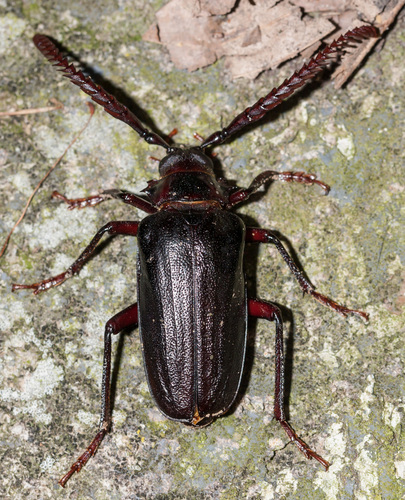
Tile-horned Prionus
Prionus imbricornis
A nocturnal giant with architecturally stunning antennae, the Tile-horned Prionus is one of North America's most impressive longhorn beetles. Often found near ancient oaks, these summer visitors bring a touch of prehistoric wonder to any backyard.
Quick Identification
Size
24-50 mm (0.9 to 2 inches) in length; males are generally smaller than females
Colors
Uniformly dark reddish-brown to nearly black; shiny elytra (wing covers) with subtle punctures
Key Features
- 16 to 20 overlapping, tile-like segments on antennae
- Large, robust, and heavy-bodied appearance
- Strong, forward-facing mandibles
- Smooth, shiny wing covers with faint longitudinal ridges
When You’ll See Them
Geographic range
Where Does the Tile-horned Prionus Live?
The Tile-horned Prionus is native to the North American continent, predominantly inhabiting the Eastern and Central United States. Its range extends from southern Canada and the Atlantic coast as far west as the Great Plains, reaching down through the Gulf States into Florida. Within this territory, it is most frequently encountered in areas with a high density of oak and chestnut trees, which serve as the primary hosts for its developing larvae.
Basemap © OpenStreetMap contributors
Behavior
The Tile-horned Prionus is a nocturnal longhorn beetle that spends the vast majority of its life cycle underground. As larvae, they are formidable root-feeders, tunneling through the root systems of various hardwood trees and shrubs for three or more years. When they finally emerge as adults during the mid-summer months, their primary focus shifts entirely to reproduction. Interestingly, adult beetles have a significantly reduced digestive system and rarely, if ever, feed, relying instead on energy reserves stored during their larval stage.
Adults are most active during warm, humid summer nights and are famously attracted to artificial light sources, which often leads them into suburban backyards. While their large size and powerful mandibles can be intimidating, they are not aggressive toward humans. However, they should be handled with care, as they can deliver a strong pinch if they feel threatened. Males are particularly active fliers, using their specialized, sensitive antennae to track the pheromones released by stationary females hidden in the leaf litter or near the base of trees.
EverydayEarth exclusive
Camera Tips
Capturing the Tile-horned Prionus on camera requires a focus on nighttime photography. Because these beetles are strongly attracted to light (phototactic), the most effective way to photograph them is by setting up a 'light trap' within view of your camera. A simple white bedsheet hung vertically with a UV or mercury vapor light shining on it will often attract several individuals. Position your camera on a tripod at roughly eye level with the sheet, using a macro lens or a close-focus setting to capture the intricate details of their 'tiled' antennae.
If you prefer a more natural setting, place your camera near the base of mature oak trees or around old, decaying stumps in late June or July. Use a low-angle mount, such as a ground spike or a 'gorillapod' wrapped around a low branch, aiming the lens at the root flare where the trunk meets the soil. This is where females are most likely to be found and where males will land to search for them. Since these beetles move relatively slowly on the ground, a standard trail camera's trigger speed is usually sufficient, but high-sensitivity PIR settings are recommended due to the insect's cold-blooded nature.
For the best results, use a camera with a good external flash or an infrared (IR) setup that won't wash out the beetle's dark, shiny exterior. If using a standard trail camera, look for one with 'no-glow' IR to avoid overexposing the beetle's reflective elytra. Setting your camera to 'Burst Mode' can help you catch the moment they take flight, which involves a clumsy but fascinating unfolding of their large wings from beneath their wing covers. High-definition video mode (60fps) is also excellent for documenting the characteristic waving motion of their thick antennae as they navigate.
Similar Species
Species that look similar or are commonly confused with Tile-horned Prionus.
Broad-necked Root Borer
Has only 12-13 antennal segments and a much broader, more pronounced pronotum (neck area) compared to the Tile-horned Prionus.
California Root Borer
Found in Western North America; has thinner antennae and is generally larger and more elongated than the Tile-horned Prionus.
Hardwood Stump Borer
Light yellowish-brown with darker spots or bands on the elytra, unlike the solid dark brown of the Tile-horned Prionus.
Frequently Asked Questions
Record Tile-horned Prionus at your habitat
Connect a camera to start building your own species record — AI identifies every visitor automatically.