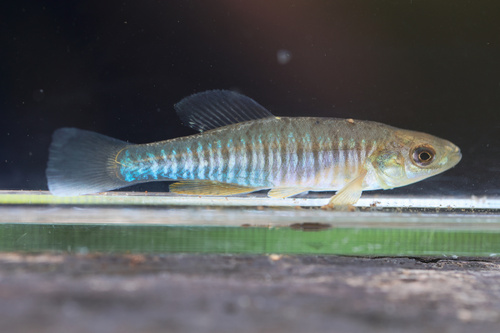
Banded Killifish
Fundulus diaphanus
A shimmering, striped gem of North America's shallows, the Banded Killifish is a master of the shoreline. Watch these social schoolers dart through underwater forests with incredible speed and agility.
Quick Identification
Size
2 to 4 inches (5 to 10 cm) in length; rarely exceeding 5 inches (12.7 cm)
Colors
Olive-green to silvery-gray back with silvery-white sides; 12-20 dark vertical bands; males have more numerous, thinner bands than females
Key Features
- Slender, torpedo-shaped body
- Small upturned mouth for surface feeding
- 12 to 20 dark vertical bars along the flanks
- Single dorsal fin set far back toward the tail
When You’ll See Them
Geographic range
Where Does the Banded Killifish Live?
Native to the North American continent, the Banded Killifish occupies a vast range from the Atlantic provinces of Canada and Newfoundland southward to South Carolina. It is widely distributed across the Great Lakes basin and the northeastern United States, with inland populations extending as far west as Minnesota and the Dakotas. While they are the only freshwater killifish in the Northeast, they also comfortably inhabit the brackish waters of Atlantic coastal marshes.
Basemap © OpenStreetMap contributors
Behavior
Banded Killifish are highly social, schooling fish that primarily inhabit the upper layer of the water column. They are known for their energetic 'darting' behavior, moving in quick bursts to navigate between patches of aquatic vegetation or to escape predators. They are incredibly hardy and adaptable, capable of tolerating wide fluctuations in temperature and salinity, which allows them to thrive in both strictly freshwater environments and brackish coastal estuaries.
These fish exhibit a unique 'flashing' behavior where they tilt their silvery bodies to reflect sunlight, a tactic often used to confuse predators or communicate with the school. Unlike many other small fish, they are relatively bold and will often approach the shore in very shallow water, sometimes only an inch deep, to forage for food where larger predatory fish cannot follow.
EverydayEarth exclusive
Camera Tips
Capturing the Banded Killifish requires an underwater setup, such as a waterproof action camera or a specialized pond-cam. For the best results, place your camera in the 'littoral zone'—the very shallow water near the shoreline where sunlight reaches the bottom and plants like eelgrass or lily pads are present. Position the lens 6 to 12 inches below the surface, angled slightly upward to catch the light reflecting off their silvery scales.
Because these fish are highly visual and active during the day, midday sun provides the best illumination for clear footage. Avoid placing cameras in areas with high silt or mud, as the Killifish's rapid movements can stir up clouds that obscure the lens. Instead, look for sandy or gravelly patches surrounded by vegetation, which act as natural 'stages' for their social interactions.
You can encourage them to linger in front of the lens by placing the camera near a natural cluster of aquatic plants where mosquito larvae or small crustaceans congregate. Since they are schooling fish, you usually won't just see one; once a 'scout' finds an area safe, the rest of the school will likely follow. Set your camera to a high frame rate, such as 60 or 120 fps, to capture their lightning-fast darting motions in crisp detail without motion blur.
Similar Species
Species that look similar or are commonly confused with Banded Killifish.
Frequently Asked Questions
Record Banded Killifish at your habitat
Connect a camera to start building your own species record — AI identifies every visitor automatically.