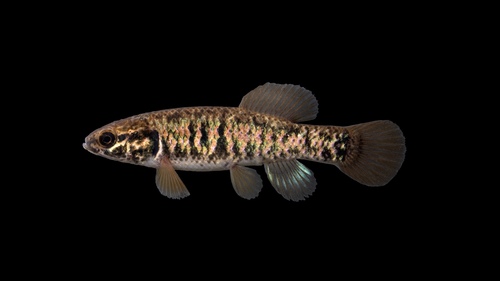
Central Mudminnow
Umbra limi
The Central Mudminnow is a remarkable survivor, capable of breathing air and burrowing into mud to escape the harshest conditions. This secretive ambush predator is a fascinating resident of North America's quietest wetlands.
Quick Identification
Size
Usually 5 to 10 cm (2 to 4 inches), though they can reach up to 15 cm (6 inches) in length.
Colors
Mottled dark brown to olive-green upper body with lighter yellowish-brown sides. Features 12 to 14 faint dark vertical bars and a distinct, dark vertical bar at the base of the tail fin.
Key Features
- Distinct black vertical bar at the base of the tail
- Rounded caudal (tail) fin
- Mottled brown and olive camouflage
- Small, cylindrical body with a flattened head
When You’ll See Them
Geographic range
Where Does the Central Mudminnow Live?
The Central Mudminnow is native to the freshwater systems of central and eastern North America. Its core range is concentrated within the Great Lakes and the upper Mississippi River basins, extending from Quebec and Ontario in Canada southward through the Midwestern United States to Arkansas and Tennessee. While largely confined to its native range, some isolated populations have been introduced to drainage systems in the western United States.
Basemap © OpenStreetMap contributors
Behavior
The Central Mudminnow is a master of survival, specifically adapted to thrive in harsh, oxygen-depleted environments where other fish species would perish. They possess a modified gas bladder that allows them to breathe atmospheric air, a trait that enables them to inhabit stagnant ditches, murky swamps, and weed-choked ponds. When their aquatic homes begin to dry up during summer droughts, these resilient fish can burrow tail-first into soft mud and enter a state of estivation until water returns.
Generally solitary and secretive, the mudminnow is a patient ambush predator. It spends much of its time perfectly still among aquatic plants or submerged leaf litter, waiting for small prey to wander within striking distance. They are not strong swimmers over long distances; instead, they move in short, quick bursts. Despite their name, they are not true minnows but are actually more closely related to pikes and pickerels.
EverydayEarth exclusive
Camera Tips
To capture the Central Mudminnow on camera, you will need a waterproof action camera or a specialized underwater trail camera setup. Because these fish are bottom-dwellers that rely on heavy cover, position your camera in shallow water (6-12 inches deep) near dense aquatic vegetation or submerged logs. Aim the lens toward a patch of soft, silty substrate rather than a rocky area, as this is where they spend the majority of their time foraging and hiding.
Lighting is your biggest challenge in the murky habitats these fish prefer. Try to place your camera in a spot that receives dappled sunlight during the day to help highlight the subtle vertical bars on their sides. Since mudminnows are masters of camouflage and often remain motionless for minutes at a time, use a high-resolution video setting (at least 1080p at 60fps) to help you distinguish their form from the surrounding debris when they eventually make a move. Setting your camera to a "time-lapse" mode with 5-second intervals can also be an effective way to monitor a specific patch of mud without draining your battery.
While they are naturally curious, you can encourage a mudminnow to appear on screen by gently disturbing a small patch of the bottom sediment just before you submerge the camera; this releases tiny invertebrates that act as natural bait. Alternatively, placing a small mesh bag filled with frozen bloodworms or brine shrimp in the frame will often draw them out of the weeds. Be sure to secure your camera firmly to a weighted base or a stake, as the soft mud can cause lightweight cameras to tip or sink over time.
During the winter, mudminnows remain active even under the ice. If you live in a cold climate, you can drop a waterproof camera through a hole in the ice in a shallow marsh area. Because they are one of the few fish that can survive in low-oxygen conditions under thick ice, you might find them congregating in large numbers where other species have disappeared. Make sure your camera's white balance is adjusted for the greenish or tea-colored water typical of mudminnow habitats to ensure the most natural color reproduction.
Similar Species
Species that look similar or are commonly confused with Central Mudminnow.
Eastern Mudminnow
Very similar in shape but found along the Atlantic coast; it typically has longitudinal stripes rather than the vertical bars of the Central species.
Banded Killifish
Has a more upturned mouth for surface feeding and lacks the characteristic dark vertical bar at the base of the tail.
Frequently Asked Questions
Record Central Mudminnow at your habitat
Connect a camera to start building your own species record — AI identifies every visitor automatically.