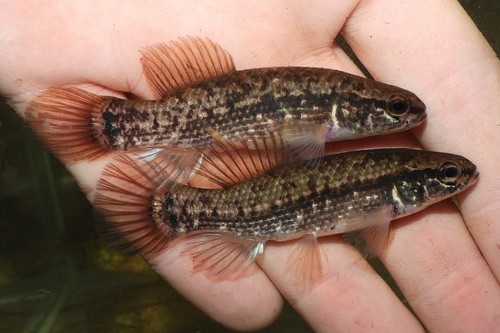
Eastern Mudminnow
Umbra pygmaea
A resilient survivor of the swamps, the Eastern Mudminnow is a master of camouflage that can breathe air and vanish into the mud at a moment's notice.
Quick Identification
Size
6.5–11.5 cm (2.5–4.5 inches) in length; rarely exceeds 15 cm (6 inches).
Colors
Olive to dark brown back with 10–12 narrow, pale horizontal stripes; a prominent vertical dark bar is located at the base of the tail.
Key Features
- Distinct dark vertical bar at the base of the tail fin
- 10-12 pale horizontal stripes along the sides
- Rounded tail and dorsal fins
- Stocky, cylindrical body with a flattened head
When You’ll See Them
Geographic range
Where Does the Eastern Mudminnow Live?
Native to the Atlantic coastal plain of North America, the Eastern Mudminnow is found from southeastern New York and New Jersey southward to the Florida panhandle. They are particularly concentrated in the low-lying wetlands of the Mid-Atlantic and Southeast United States. Beyond their native range, established introduced populations can now be found in several European countries, including France, Belgium, Germany, and the Netherlands, where they inhabit similar sluggish, muddy waterways.
Basemap © OpenStreetMap contributors
Behavior
The Eastern Mudminnow is a master of survival, specifically adapted for life in stagnant, low-oxygen environments that would be lethal to most other fish. They possess a modified swim bladder that functions similarly to a lung, allowing them to gulp atmospheric air from the surface when oxygen levels in the water drop. This unique adaptation makes them common residents of weed-choked ditches and acidic swamps.
True to their name, these fish use the mud as a primary defense mechanism. When startled or pursued by a predator, they dive headfirst into the soft substrate, wriggling deep into the silt to disappear entirely. They are primarily solitary and secretive, spending most of their day hovering motionless among aquatic vegetation or leaf litter, waiting to ambush unsuspecting prey.
While not aggressive toward humans, they are rarely seen by casual observers due to their exceptional camouflage and preference for murky water. They are hardy enough to survive in backyard ponds that may have poor water quality or high acidity, making them a fascinating, albeit elusive, species for local wildlife enthusiasts to track.
EverydayEarth exclusive
Camera Tips
To capture the Eastern Mudminnow, you will need an underwater trail camera or a waterproof action camera set to time-lapse or motion-detection mode. Position your camera in shallow water, approximately 6 to 12 inches deep, near the edges of a pond or ditch where aquatic plants are dense. Aim the lens downward at a 45-degree angle toward a patch of dark leaf litter or a break in the vegetation, as mudminnows love to hover at the transition zones between cover and open water.
Baiting is highly effective for this species. Place a small mesh bag containing frozen bloodworms, chopped earthworms, or crushed snails directly in the camera's field of view. Because these fish are small and rely on camouflage, set your camera to its highest resolution and use a macro focus setting if available. If the water is murky—as is common in mudminnow habitats—keep the bait and camera within 12 inches of each other to ensure clear detail of their horizontal stripes.
Seasonal timing is key for the best footage. During the spring (March to May), Eastern Mudminnows move into very shallow flooded areas to spawn, providing excellent opportunities for high-quality video. If filming at night, ensure your camera has infrared (IR) capabilities, as they continue to forage after dark. Avoid using bright white lights which can wash out their subtle color patterns and potentially startle them in the confined spaces of a swampy margin.
Similar Species
Species that look similar or are commonly confused with Eastern Mudminnow.
Frequently Asked Questions
Record Eastern Mudminnow at your habitat
Connect a camera to start building your own species record — AI identifies every visitor automatically.