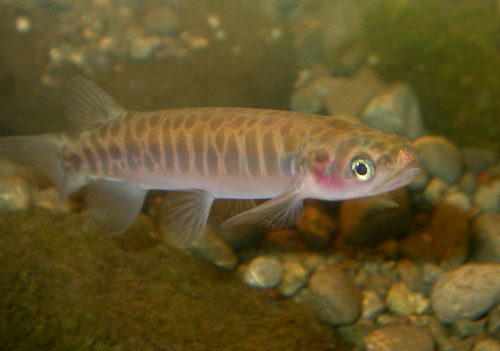
Banded Kōkopu
Galaxias fasciatus
The Banded Kōkopu is a hidden gem of New Zealand’s forest streams, known for its striking golden stripes and its incredible ability to climb waterfalls as a juvenile.
Quick Identification
Size
Typically 20–25 cm (8–10 in), with rare individuals reaching up to 30 cm (12 in)
Colors
Dark olive-brown to blackish-green body with numerous thin, pale-yellow to silver vertical bands; juveniles often have more distinct golden flecks
Key Features
- Pale vertical bands (stripes) along the flanks
- Large, fan-like pectoral fins positioned low on the body
- Lower jaw slightly longer than the upper jaw
- Thick, slimy skin without visible scales
When You’ll See Them
Geographic range
Where Does the Banded Kōkopu Live?
Native to the lush, temperate islands of Oceania, the Banded Kōkopu is a quintessential New Zealander, found across the North, South, Stewart, and Chatham Islands. These secretive fish thrive in well-shaded, small-to-medium forest streams, particularly those with a dense canopy and plenty of leaf litter. While they are most abundant in coastal regions, their remarkable climbing ability allows them to establish populations in high-altitude headwaters far inland, provided there is continuous forest cover connecting the stream to the sea.
Basemap © OpenStreetMap contributors
Behavior
The Banded Kōkopu is a master of the night, spending its daylight hours tucked away in the shadows of undercut banks, fallen logs, or deep leaf litter. As dusk falls, they emerge into the open pools of forest streams to hunt. They are remarkably territorial and sedentary as adults, often staying in the same small stretch of a creek for several years, though they are capable of explosive bursts of speed when startled or when lunging for prey.
One of their most fascinating behaviors is their 'climbing' ability during the juvenile stage. Known as part of the 'whitebait' run, young kōkopu use the surface tension of the water and their specialized fins to scale vertical rock faces and waterfalls. This allows them to colonize upstream habitats that other fish simply cannot reach. In a backyard setting with a healthy stream, they may become somewhat accustomed to light, though they remain naturally shy and will dart for cover at any sudden vibration or movement on the bank.
EverydayEarth exclusive
Camera Tips
To capture the Banded Kōkopu, you need to think like a nocturnal underwater photographer. If your camera is waterproof (like a GoPro or a specialized underwater trail cam), submerge it in a slow-moving pool just below a small riffle or waterfall. Position the lens horizontally, aimed toward an undercut bank or a cluster of submerged logs where the fish are likely to emerge at night. Using a weighted mount is essential to keep the camera steady against the current.
For those using standard trail cameras above the water, look for 'plunge pools' where the water is clear and still. Mount the camera on a branch or stake angled at 45 degrees toward the water surface. Because Banded Kōkopu are most active in total darkness, ensure your camera has high-quality No-Glow Infrared (IR) LEDs. Standard white flash will likely spook the fish and cause them to retreat into the shadows for the rest of the night. Set your camera to video mode (10-20 seconds) with high sensitivity, as the movement of a fish underwater can be subtle to a PIR sensor.
Timing is everything with this species. While they are present year-round, they are most active during warm, humid nights after a light rain, which washes terrestrial insects into the stream. Avoid placing cameras during heavy floods, as the turbidity will ruin the visibility and the fish will stay deep in their burrows. If you are struggling to get them on camera, try 'chumming' the surface with a few crickets or mealworms just before dark to encourage them to feed in front of your lens.
Similar Species
Species that look similar or are commonly confused with Banded Kōkopu.
Frequently Asked Questions
Record Banded Kōkopu at your habitat
Connect a camera to start building your own species record — AI identifies every visitor automatically.